
Almost every big guide to law firm SEO is secretly written for one reader: a personal injury firm in a major metro with a five-figure monthly budget and a marketing director to spend it. If that's you, close this tab. Those guides are good and they're yours.
This one is for the solo practitioner and the three-attorney firm. The estate planner in a mid-size city, the immigration lawyer competing with two other firms in town, the IP attorney whose site was built on GoDaddy in 2019 and hasn't been touched since. What follows is the whole subject, in the order a small firm should actually approach it, with real numbers where numbers exist.
What's in this guide:
- What law firm SEO is
- Whether it's worth doing at all
- What it costs in 2026
- Step one: local, before anything else
- Step two: practice-area pages carry the weight
- Step three: the technical baseline
- Step four: someone other than you has to say it
- The AI layer
- DIY or hire, and how not to get burned
- How long it takes, honestly
What law firm SEO is
Law firm SEO (search engine optimization) is the work of making your firm's website show up when someone searches for the legal help you provide, especially searches that combine a practice area with a place, like "divorce lawyer in Tulsa." It covers what's on your pages, how your site is built, and what the rest of the web says about your firm.
Those three layers matter in that order for most small firms, and each one caps the others. Brilliant content on a site crawlers can't read goes nowhere. A technically perfect site nobody else on the internet has ever mentioned struggles to rank for anything competitive. The rest of this guide walks the layers one at a time.
One distinction worth making early: SEO is not advertising. An ad stops the moment you stop paying. A page that ranks keeps sending inquiries at no marginal cost, which is the entire economic case for doing this instead of, or alongside, paying for clicks.
Whether it's worth doing at all
Fair question, because for a small firm the honest answer isn't automatic.
Referrals are still your best channel. Clio's Legal Trends Report puts referrals as the top lead source for 59% of solo and small firm lawyers, and no amount of SEO changes that. What SEO gives you is the second channel, the one that works while nobody happens to be recommending you at a dinner party. It's also the channel that catches the client who has no lawyer friends to ask.
The math on visibility is blunt. Backlinko's study of four million Google search results found the first organic result takes 27.6% of clicks, the top three together take 54.4%, and the entire second page splits 0.63%. Past position three, you're fighting for scraps.
And the searches you'd want to win are expensive to buy instead: legal keywords routinely cost over $100 a click in paid ads, with competitive injury terms running several times that. Ranking organically for even a handful of the right local queries replaces spend you'd otherwise never stop paying. Which queries to target when you can't outspend the big firms is its own subject, worked through in keyword strategy for solo law firms.
Google is also still where the clients are, despite the AI noise. A 2025 iLawyer Marketing survey found 86.7% of people research attorneys on Google, against 28.1% who'd use ChatGPT. That second number tripled in two years, which is why the AI layer gets its own section below. But the foundation is still search, and the same work feeds both.
What it costs in 2026
Here's the section most guides skip, because most guides are written by agencies that would rather quote you on a call.
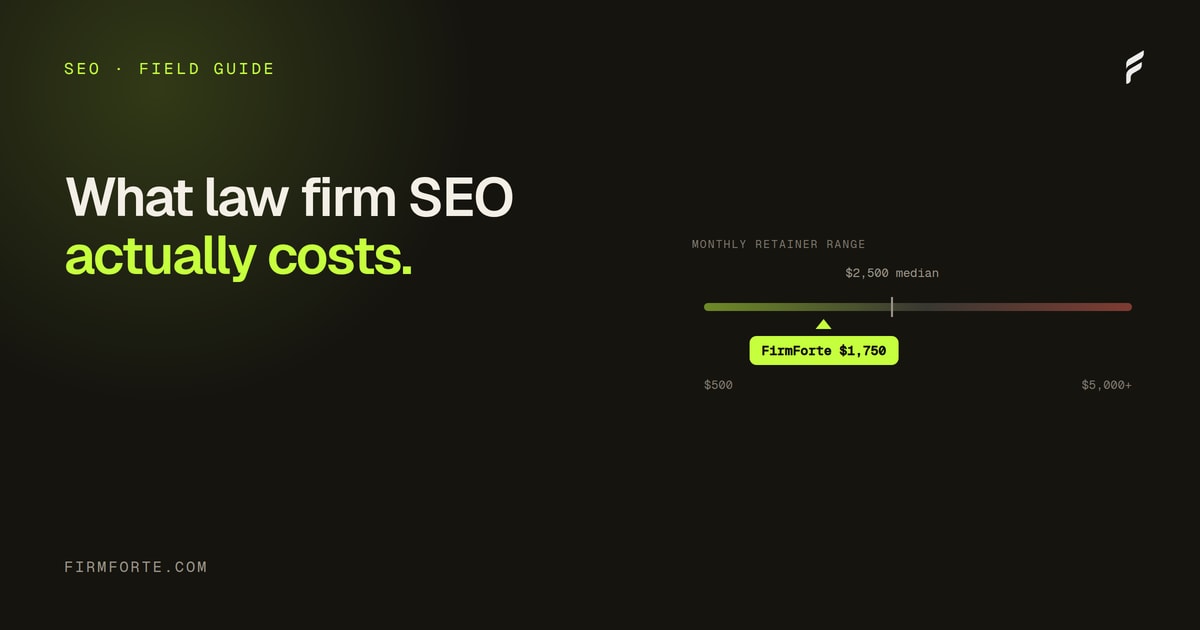
Agency retainers for law firm SEO in 2026 mostly land between $2,500 and $10,000 a month. The legal industry median sits around $4,083. Large firms in brutal markets (personal injury in Houston, say) spend $15,000 to $30,000 and consider it rational, because one signed case covers a year of it. At the other end, a solo in a smaller market can find legitimate help under $2,000 a month, though most quotes come in well above that.
Ours is $1,750 a month, flat, posted publicly, cancel after month three. That's not a teaser rate; it's the price, and the reasons it can sit below the median without the work being worse are on the pricing page. We broke down the whole market's pricing, including where the hidden costs live, in law firm SEO pricing in 2026.
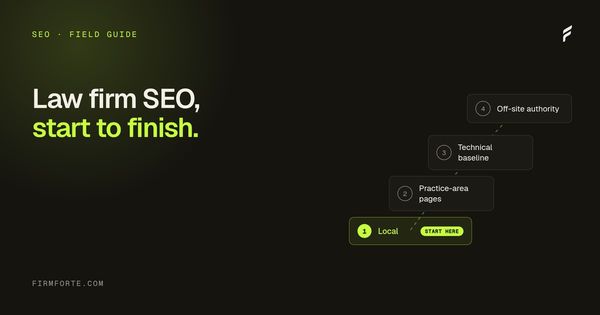
And DIY costs time instead of money. A motivated lawyer can do the first 60% of this work personally. The remaining 40% is where it gets slow. Where the line falls for you is the subject of the hiring section below. Whichever route you take, the work happens in the same order, and the order matters:
Step one: local, before anything else
For a small firm, local SEO isn't a part of the strategy. It mostly is the strategy. The map pack (the three-business Google Maps block above the regular results) drives a huge share of calls for "[practice area] lawyer [city]" searches, and your Google Business Profile is what decides whether you're in it. Local and organic aren't a choice so much as a sequence, and which to prioritize first is the subject of local SEO vs organic SEO for law firms.
Claim the profile if you haven't. Set the primary category to your actual main practice area, not the generic "Lawyer." Fill in hours, services, photos of the real office and the real attorneys. Then ask happy clients for reviews, steadily, forever, because review recency and volume are among the strongest local ranking signals there are. The full walkthrough is in our Google Business Profile guide.
Then the tedious part: NAP consistency. Your name, address, and phone need to match character for character everywhere they appear. Your site footer, your GBP, your state bar listing, Justia, Avvo. "Suite 200" on one and "Ste. 200" on another sounds trivial and isn't; every mismatch fragments your firm into weaker, separate entities in the engine's eyes. An afternoon of cleanup here outperforms a month of blogging, and it's free.
Step two: practice-area pages carry the weight
If local signals decide whether you appear on the map, practice-area pages decide whether you rank for anything typed into the search box. This is where small firm sites leak the most.
The failure pattern is always the same: one thin "Practice Areas" page with a paragraph each for five services. That page will never beat a competitor whose entire page is about the one thing your paragraph mentions in passing. The baseline is one substantial page per service you actually want cases in, each written as if it's the only thing you do. What the legal problem is, how you handle it, what it costs, the deadlines and statutes specific to your state, and the questions clients actually ask, answered on the page in two or three tight sentences each. The full case for why these earn their keep, and how to build one, is in practice-area pages: the highest-ROI page a firm builds. This is also why publishing volume is the wrong goal: one deep page beats ten thin ones, and the honest pace for a small firm is in how much a law firm should actually publish.
Those question-and-answer blocks matter more every year, for reasons covered in how to write a law firm FAQ page that gets cited. And the pages need to link to each other where it's natural, because stranded pages rank worse; that's internal linking for law firms.
Write for one reader: the person with the problem. Not for peers, not for the bar, not for Google. The strange truth of modern SEO is that the page that most plainly helps a worried human is also the page the machine prefers.
Step three: the technical baseline
You don't need to become a developer. You need to confirm five things, and most take minutes. The full version, item by item, is in a technical SEO checklist for law firm websites.
First, indexability. Search site:yourfirm.com on Google and see whether your page count roughly matches reality. Visit yourfirm.com/robots.txt and make sure nothing important is disallowed, including the AI crawlers (GPTBot, ClaudeBot, PerplexityBot). Second, mobile speed, via PageSpeed Insights, because most legal clients are on phones. Third, page titles: every page should have a specific one ("Austin Trademark Attorney | Reyes & Park"), not "Home." Fourth, that your content exists as real HTML text rather than JavaScript-rendered mush, which is the specific way website builders quietly sabotage law firms; the details are in why website builders get firms killed in AI search.
Fifth, schema markup, and here's our honest position on it, which differs from what a lot of the industry sells: schema is hygiene. LegalService, LocalBusiness, FAQPage, and Person markup should all be on your site, and the full set is in the seven schema types every law firm website needs. It makes your pages legible to machines and eligible for rich results. What it is not is a magic lever that makes engines cite you. Anyone selling markup as the secret is selling the easy part.
Step four: someone other than you has to say it
Your website claiming you're an excellent estate planning attorney counts for almost nothing, because every website says that about its owner. Engines weight what independent sources say, and this is the layer small firms neglect longest because it feels like someone else's job.
The floor is cheap and mechanical: your bar profile lists your actual practice areas, your Justia and Avvo profiles are claimed and accurate, your local legal directories agree with your homepage. Above the floor, it's earned attention. A quote in the local paper, a bar association article, a guest column, a podcast appearance. One link from a law school or a real news outlet is worth more than fifty directory submissions, and the difference between earning those and buying junk is the subject of what digital PR for attorneys actually means.
This layer is also where Google's quality standards bite hardest. Legal content falls under the search quality bucket Google calls YMYL ("your money or your life"), which means it holds lawyer sites to higher proof-of-expertise standards than a bakery's. What that means in practice, and how a small firm demonstrates real expertise, is in E-E-A-T for law firms. The broader off-site playbook is in off-site SEO for law firms.
The AI layer
A growing share of legal questions now get answered by ChatGPT, Perplexity, Claude, and Google's AI Overviews instead of ten blue links. These engines don't rank a list for the user to pick from. They retrieve a few sources, write an answer, and name one or two firms. Being third is worth nothing; there is no third.
The good news for anyone who's read this far: the work is mostly the same work. An AI engine cites firms it can recognize as real entities (that's your NAP consistency), whose claims are corroborated by independent sources (that's your off-site layer), and whose pages contain clean, liftable answers (that's your FAQ blocks). You don't run a separate playbook. You run this one and make sure the AI crawlers aren't blocked.
Where the two disciplines genuinely differ, and where the extra work lives, is covered in AEO vs SEO for law firms and how AI engines decide which law firm to cite. One warning: be skeptical of anyone who guarantees you AI citations. Nobody controls what these engines say, including us. What you control is being the easiest firm to cite correctly.
DIY or hire, and how not to get burned
Do it yourself first. Seriously. Run the 90-minute audit this weekend: it'll tell you whether your problems are the cheap kind (unclaimed GBP, inconsistent NAP, generic titles) you can fix personally, or the expensive kind (a site that needs rebuilding, a content library that doesn't exist). Plenty of firms fix the cheap kind and stop there, satisfied, and that's a fine outcome.
Hire when one of three things is true: you're in a genuinely competitive market where the free fixes ran out, you don't have four hours a month to spend on this, or you've been publishing for a year and nothing moved.
Then hire carefully, because legal marketing is where bad agency behavior goes to retire wealthy. The tells are consistent. Twelve-month contracts with no exit. "Proprietary platforms" that mean you lose the site if you leave, which is a bigger deal than most lawyers realize until it happens; see who owns your law firm website. Reporting that celebrates impressions instead of phone calls. Guaranteed rankings, which nobody honest offers. And pricing you can only learn on a call, which exists so the number can change depending on how the call goes. The full catalogue is in the hidden fees legal agencies bury in contracts.
Whatever you sign, confirm in writing that you own the domain, the site, and every word of content if you leave. An agency that hesitates on that question has answered it.
How long it takes, honestly
Months one to three are groundwork: fixes, cleanup, the first real pages, and Google re-reading your site. Expect movement on long-tail and local queries somewhere in months three to six. Consistent inquiries from organic search typically show up between months six and twelve. After that it compounds, the way a referral reputation does, because every ranking page keeps working while you build the next one.
Anyone promising first-page rankings in 30 days is describing either a keyword nobody searches or a lie. The flip side of the slow build is the moat: a competitor can't buy their way past rankings you earned. They have to do the same eighteen months of work. For the stage-by-stage version, including the leading indicators that tell you it's working before the phone rings, see how long law firm SEO takes to bring in cases.
One last thing, and it's the most encouraging fact in this whole guide. Your competition is not the personal injury giants with the five-figure retainers. It's the other small firms in your city, and most of them have an unclaimed Business Profile, a homepage that says "Justice. Integrity. Results." in an image file, and a robots.txt nobody has ever read. The bar you have to clear is sitting on the ground. Start with the free scan, fix what it finds, and you're ahead of most of them by Labor Day.