
A criminal defense firm in Phoenix called us last fall to ask why their off-site SEO retainer wasn't producing results. They were paying $2,400 a month for "authority building." I asked them to forward me the agency's last six monthly reports.
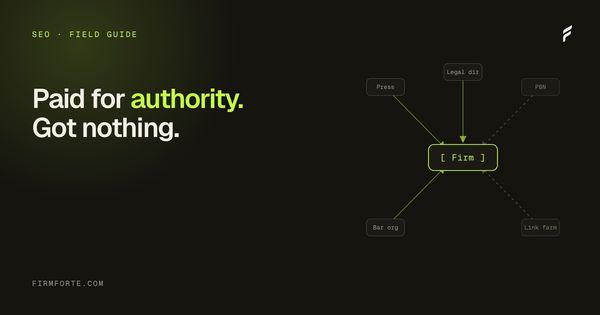
The reports showed 47 "authority placements" across the period. I opened the first ten. Six were guest posts on websites that ranked nowhere for anything related to legal. Two were paid press releases on PRWeb. One was a comment on a forum. One linked from a website about CBD oil to a personal injury practice in Phoenix. The agency was billing them for backlinks the AI engines have specifically learned to ignore, attached to sources Google's spam classifier flags by default.
That conversation is the reason I wanted to write this post. The phrase "off-site SEO" still carries baggage from 2018. Buy backlinks. Submit to 200 directories. Trade guest posts. None of it works for law firms anymore. Some of it actively hurts. Google's spam updates and AI engines have spent five years learning to distinguish real authority signals from manufactured ones, and the legal vertical gets extra scrutiny because of its YMYL status (more on which in the E-E-A-T for law firms guide).
What follows is the ranked list of off-site sources that actually move authority for law firms in 2026. From highest weight to lowest. Plus the ones that produce zero return, or worse.
Off-site authority · heaviest first
Tier one: state and county bar directories
The single highest-weight off-site signal a law firm site has. Google's quality raters explicitly reference bar listings as a trust signal in the rater guidelines. AI engines treat the state bar as a near-canonical source of "who is a licensed attorney in this state."
What this looks like practically:
- Every attorney at the firm has a complete, current bar listing on the state bar website
- The listing's name, address, and phone match the firm site exactly
- If the bar listing has a profile or biography field, it's filled in. Most firms leave this blank.
- County bar listings get the same treatment, in markets where county bars maintain directories
- Firms with multiple offices have a listing reflecting each office, not just the headquarters
The single change with the highest leverage: go to your state bar's online directory right now. Look at the listing for your lead attorney. If the profile field is blank, fill it in this week. If the address is missing the suite number, fix it. If you're listed under "Smith, John" but the website says "John A. Smith," reconcile the two. This work takes an afternoon. The impact shows up within a few weeks.
State bar systems referenced most often in AI citation patterns:
- California State Bar (member.calbar.ca.gov)
- State Bar of Texas (texasbar.com)
- The Florida Bar (floridabar.org)
- New York State Unified Court System (iapps.courts.state.ny.us/attorneyservices)
- State Bar of Michigan, Illinois, Pennsylvania, Ohio, Georgia (similar weight)
The relative weight scales roughly with population. Smaller-state bars matter just as much for firms practicing in those states; the rankings above reflect which directories AI engines reference most often in citation patterns across markets.
Tier two: specialty legal aggregators
Avvo, Martindale-Hubbell, Justia, FindLaw, Lawyers.com. Most law firms have profiles on these. Most treat them as set-it-and-forget-it. That's the mistake.
What matters on each:
- Profile completeness (every field filled, no defaults left in place)
- Practice area selections match the actual work the firm does
- Verified credentials where the platform allows verification
- Client reviews handled honestly (responses to negatives, no obvious scrubbing)
- Q&A participation where the platform supports it (Avvo especially)
The Avvo profile completeness checklist, in order of weight:
- Practice area selection accurate, not too broad, not too narrow
- Bar admission verified through Avvo's system
- Professional headshot uploaded (not the default placeholder)
- Education listed with law school name and graduation year
- Languages spoken, if relevant
- Awards and honors, verifiable, not paid placements
- Publications and presentations
- Free consultation flag set accurately
- Client reviews (encourage existing clients to leave honest reviews)
- Q&A answers (post substantive answers to client questions)
Avvo's Q&A in particular punches above its weight. Substantive answers to client questions get indexed, get cited in AI summaries, and link back to the responding attorney's profile. An attorney who answers two questions a week for a year builds visible authority that's hard to fake.
Martindale-Hubbell specifics:
- AV Preeminent rating (peer-reviewed, the gold standard, hard to game)
- BV Distinguished and similar tiers
- Notable Lawyer designation
- Profile completeness scoring
- The "Client Champion" badge if you've earned it through client reviews
The Martindale rating system, despite being old-school, still carries weight in AI citation patterns because the peer-review methodology is one of the few external indicators of professional standing that an AI engine can verify.
Tier three: court records and case databases
Public court records mention attorneys by name. PACER for federal cases, state-level dockets where they're searchable, Justia's case law database, CourtListener, RECAP. Your firm name and named attorneys' names appearing in real case records is a genuinely independent authority signal that's hard to fake.
Two things firms can do to maximize this:
First, make sure the attorney's name format in court filings matches the format used on the firm site. "John A. Smith" on filings, "John Smith" on the website, and "J. Smith" on Avvo creates three weakly-linked entities instead of one strong one. Pick a canonical format and use it everywhere. For more on how AI engines link these into a single entity, see how AI engines build an entity graph of your firm.
Second, link from attorney bios to notable case records where appropriate. A bio that says "represented appellant in Smith v. Acme (Cal. Ct. App. 2024)" with a real link to the published opinion is more credible than one that says "appellate experience." The link gives the AI engine a verifiable confirmation.
Free tools to find your firm's case history:
- CourtListener (free, searchable, includes attorney name)
- Justia case law database
- Google Scholar's case law tab (search by your firm name)
- RECAP archive
- Bloomberg Law and Westlaw, if you have access
A 30-minute search through these surfaces will usually turn up case records you'd forgotten about. Linking from bios to those records is free authority signal.
Tier four: legal industry publications and regional press
Quotes in regional newspapers. Articles in Law360, Bloomberg Law, the ABA Journal, state bar journals. Guest posts on serious legal industry publications. Podcast appearances on practice-specific shows. Each one is an independent confirmation by a source that has some claim to editorial standards.
The bar to clear keeps rising. AI engines have learned to discount the lowest-tier "guest post" sites (those that accept any submission, often for a fee) and to weight publications with real editorial review. The practical heuristic: if you can buy your way onto the site, it doesn't count. This is also the line most agencies blur when they sell "digital PR" that's really directory submissions, which is worth understanding before you buy any of it: what digital PR for attorneys actually means.
A regional press pitch template that actually works:
Subject: [Specific story angle] — quick comment from [Practice Area] attorney
Hi [Reporter Name],
I noticed your piece on [recent story]. We've handled [number] similar cases in [region] in the last [time period], and there's a pattern in those cases that hasn't come up in the coverage so far: [specific insight].
If it's useful for a follow-up, happy to share details on background or on record.
[Signature with bar admission and direct phone]
That template lands placements at roughly a 15% reply rate when targeted properly. Three placements a year is enough to move the authority needle for a small practice. The key is specific insight tied to real case experience, not generic commentary.
Publications worth pitching, by practice area:
- Personal injury / plaintiff: Law360, The American Lawyer, AAJ Trial Magazine, regional newspapers, local TV legal correspondents
- Criminal defense: NACDL's The Champion, ABA Journal, state criminal defense bar publications
- Family law: Family Lawyer Magazine, AAML newsletters, regional family law journals
- Business / commercial: Law360, Bloomberg Law, Forbes Council, state commercial law journals
- Estate planning: Trusts & Estates, Wealth Management, state estate planning section newsletters
National publications carry weight but they're competitive. Regional publications and practice-specific journals are easier to land and the weight per placement is nearly as high for AI citation purposes. Running this earned-placement work is the core of our Digital PR and attorney branding service.
Tier five: schools and professional associations
Law school alumni pages, especially for top schools. Specialty bar associations (NACDL, AAJ, AAML, ACTL, ABOTA). Continuing legal education providers, if the attorney has taught. State and local Inns of Court.
These are slow to accumulate but durable. Once a law school lists an alumnus on a notable graduates page, that link tends to stay forever and accrue authority. Once a specialty bar invites a member to teach a session, that listing becomes a permanent credential.
Quick wins in this tier:
- Reach out to your law school's alumni relations office. Many schools maintain "notable alumni in [practice area]" pages and welcome additions for verified members.
- Apply to teach one CLE per year through your state's CLE provider. The teaching credit lasts indefinitely on your bio.
- Join the practice-specific national bar association most relevant to your work, and complete the public member profile.
- Inns of Court membership is a slow-build signal that carries weight in regional markets.
The negative list: what produces zero return (or worse)
The Phoenix firm we opened with was paying $2,400 a month for placements that fell entirely into the categories below. The list is worth memorizing.
Stop spending money on:
- Paid press release distribution (PRWeb, eReleases, etc.) — actively discounted by Google and AI engines
- "Guest post" placement services offering bulk submissions
- Generic business directory submissions (yellowpages.com, manta, etc.)
- Link exchanges with non-legal sites
- Reciprocal "best of [city] [year]" award sites that charge a fee
- Mass blog comment campaigns
- Link insertion services targeting expired domains
- "Sponsored content" on sites that publish anything submitted
- Programmatic city pages (covered separately in why we stopped building location landing pages)
The Phoenix firm we audited had been paying $2,400/month for two years. We told them to cancel the retainer and redirect the budget to one regional press pitch a month, a quarterly Avvo audit, and one new CLE teaching engagement per year. Within six months their AI citation rate on target queries went from zero to roughly 35%. The budget reallocation, not new spend.
The quarterly off-site audit
One pattern that works for firms managing this internally:
A 90-minute quarterly review of every off-site surface. Bar listings checked, legal aggregator profiles updated, new press mentions catalogued, NAP inconsistencies fixed. This is unglamorous, recurring work. It's how firms with no PR budget out-rank firms spending five figures a month on backlink campaigns.
Quarterly checklist:
- State bar profile current and complete
- County bar profile current and complete
- Avvo profile filled out, last review date noted
- Martindale profile current
- Justia, FindLaw, Lawyers.com complete
- Google Business Profile updated with new posts or photos
- Any new press mentions saved and linked from bio pages
- Court records (PACER, state) checked for new entries
- NAP consistent across all surfaces
- At least one new earned mention added since last quarter
That's the work. Most agencies don't do it because it doesn't fit into a billable workflow. The firms that take it on internally, or have a marketing partner who actually does it, see the compounding return show up around month nine or ten.
For deeper coverage of how this authority work feeds into AI citations, see the foundational guide to getting cited by ChatGPT and AI engines. For the on-site companion work that pairs with this, the internal linking guide for law firms walks through how to structure the site itself.