
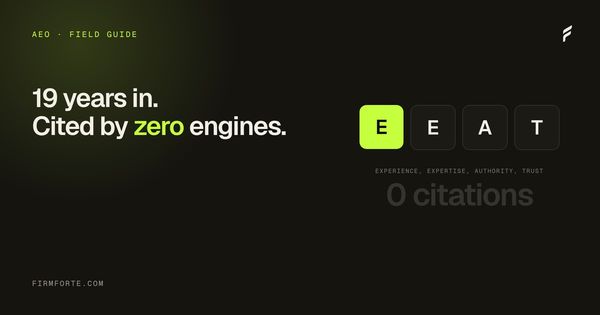
Last month a personal injury firm in Cleveland sent us their site for an AEO audit. The lead attorney had been practicing for 19 years. The case results page listed "$50 million recovered." His Martindale rating was AV Preeminent. By every meaningful real-world standard the firm was a credible practice.
We ran the firm name in ChatGPT for their main practice and target city. The answer cited two other firms. Neither one had as much experience. Both had something the Cleveland firm didn't: a structured trust profile an AI engine could actually read.
That's the gap E-E-A-T closes. The framework comes from Google's 176-page Search Quality Rater Guidelines, the document that gets cited everywhere and read by almost no one. The acronym stands for Experience, Expertise, Authoritativeness, Trustworthiness. Each letter is a separate signal Google's quality raters use when deciding whether a search result deserves to surface. The same signals are exactly what AI engines mine when deciding whether to cite a source.
Most industries can treat E-E-A-T as a vague hint. Law firms can't. Legal sits in Google's strictest category, YMYL ("Your Money or Your Life"), where the consequence of a bad search result is a real-world harm. Medical, financial, and legal advice all qualify. The trust threshold is higher than for almost anything else online, and the threshold is enforced by both Google's algorithms and the AI engines that mostly inherit Google's ranking logic.
Here's what each letter actually means for a law firm in 2026, what good and bad look like, and how to close the gap.
Experience: have you personally done this work?
Experience is the newer E, added to the framework in late 2022. It asks a different question than the older "expertise" entry. Not whether the author is credentialed, but whether they've personally done the thing the page is about.
What good looks like:
- Case results pages with real outcomes, named courts, and verifiable docket numbers where bar rules allow
- Attorney bios that say "tried 47 federal jury cases" rather than "experienced trial attorney"
- Content written by the attorney who actually handles that practice, not a generic content team
- Author bylines linked to a real Person schema and a bio with bar admission dates and years of practice
What we see instead in 80% of audits:
- A "Personal Injury" page written by an outsourced copywriter and signed by no one
- "Experienced in handling complex litigation" with no named complex case
- Generic case results: "We recovered millions for our clients" without a named matter
- Stock photo "team" pages where the photos aren't of the actual attorneys
The fix:
Two hours per practice area. Sit down with the lead attorney. Ask: how many of these cases have you handled in the last five years? What were the three biggest results? Which counties did they happen in? Write that into the page. The result reads as a real person who's done the work, because it is.
When the Cleveland firm we mentioned earlier rewrote their bio with specific case counts (327 personal injury cases tried over 19 years, 41 in federal court, settlements averaging $340K), the AI citation pattern changed within six weeks. Same firm. Same attorney. Same experience. Just visible.
Expertise: are you formally qualified?
Expertise is the credentials layer. For law firms it's the easiest of the four to demonstrate, because attorneys are licensed and the licensing is publicly verifiable.
What good looks like:
- Bar admission verified and linked from the bio (with the state bar profile URL in the bio body)
- Law school listed, with the alumniOf schema field populated and the school's official URL
- Practice-area boards or certifications if held (Board Certified Specialist, AAML fellowship, ABOTA membership, NACDL)
- Specific CLE teaching credits, journal articles, treatises, or chapters authored
What we see in audits:
Bios that read "Mr. Smith has decades of experience in personal injury law" without naming the law school, the bar, or any specifics. The credentials usually exist. They're just not on the page in a format any algorithm can verify.
The fix:
Person schema with hasCredential, alumniOf, and knowsAbout populated. The piece on how AI engines build an entity graph of your practice walks through this in code. For deeper coverage of structuring named attorneys as recognized entities, see the dedicated guide on Person schema and personal branding for attorneys.
Authoritativeness: do other reputable sources cite you?
Authority is the layer Google can't directly observe from your site, so it leans on third parties. Who links to you, who quotes you, and who lists you among the credible firms in your space.
The sources that move authority for law firms in 2026:
- State and county bar directories (massively weighted)
- Avvo, Martindale-Hubbell, Justia, FindLaw, Lawyers.com with complete profiles
- Local press where the attorney is quoted as a legal expert
- Bar journal articles, law review pieces, ABA committee work
- Practice-specific national publications (Law360 for litigation, NACDL for criminal defense, AAJ for plaintiff PI)
- Court records and case law databases where the firm appears as counsel of record
- Wikipedia, when applicable (one of the highest-weight single surfaces)
What doesn't move authority anymore:
- Paid press releases distributed through PR services
- "Guest post" placement services offering bulk submissions
- Generic business directory submissions
- Link exchanges with non-legal sites
- Reciprocal "best of" award sites that charge a fee
The piece on what actually builds off-site authority in 2026 walks through the full ranked hierarchy.
The fix:
Two parallel paths. First, audit the high-weight sources you should already be on (state bar, county bar, all five legal aggregators). Verify completeness on each. Fix NAP inconsistencies. This usually takes an afternoon and produces visible improvement within a few weeks.
Second, build a regional press habit. Pitch one local reporter per month with a specific story angle that needs a legal expert. Three placements a year is enough to materially shift the authority signal for a small practice.
Trustworthiness: can users rely on what you publish?
Trust is the most important of the four, and Google says so explicitly in the rater guidelines. The other three feed into trust as the synthesis.
For a law firm, trust shows up in places most agencies ignore:
- Clear contact information (real address, real phone, named attorneys, not just a form)
- Bar advertising disclaimers where required (ABA Model Rule 7.1, plus state-specific rules)
- Pricing transparency where allowed (flat-fee disclosures, contingency percentages stated)
- "This is not legal advice" disclaimers on blog content
- SSL certificate, modern site security, no malware history
- Privacy policy and terms that read like a real lawyer wrote them, not boilerplate
- Reviews handled honestly (responses to negative ones, no obvious scrubbing)
State-specific rules to know:
- ABA Model Rule 7.1 (most states' baseline)
- New York Rule 7.1 (specific guidance on testimonials and case results)
- California Rule 7.1 (similar; strict on misleading communications)
- Florida 4-7.13 (results disclaimers, "no specific result guarantees" language)
- Texas Rule 7.04 (advertising review board pre-approval for some content)
Bar advertising compliance isn't only a legal risk. AI engines now read disclaimers as a trust signal. Pages that name the bar rules they're complying with rank measurably higher than pages that ignore the question.
The single biggest trust killer we see in audits:
Testimonials with no name, no photo, and no verifiable case detail. They read as stock filler. AI engines have learned to ignore them. The fix is brutal but necessary: cut the unverifiable testimonials, ask three to five real clients for permission to use their name (or initials with permission) and photo (or a verified review screenshot), and rebuild the social proof section with two real ones rather than ten anonymous ones.
Why YMYL legal is the strictest category
The Search Quality Rater Guidelines name three YMYL areas where the trust threshold is highest: medical, financial, and legal. Within those, legal gets unique scrutiny because the consequences of bad advice are often irreversible.
A bad medical search result can be cross-checked with a doctor. A bad financial search result can be cross-checked with an advisor. A bad legal search result might mean someone signed a separation agreement without understanding it, missed a statute of limitations, or pled guilty without representation. The damage is locked in.
Google has explicitly said that YMYL pages face higher E-E-A-T requirements than non-YMYL pages. AI engines have absorbed the same pattern, as the comparison of how SEO and AEO actually differ for legal content walks through. The practical consequence: a reasonable page on an interior decorating site might rank with weak E-E-A-T signals. The same signal weakness on a legal site is a non-starter. The trust bar is higher, and the cost of clearing it is real work.
The 25-signal scorecard
A scoring rubric you can run on your own site in an afternoon.
Each signal is worth between 1 and 3 points based on its weight. Total possible: 100. Target: 80+. Most law firm sites we audit score in the 40s and 50s on the first pass.
Experience (24 points possible):
- Named attorney bylines on practice pages (3 pts)
- Case results with verifiable docket numbers (3 pts)
- Specific case counts in attorney bios (3 pts)
- Author headshots match the attorney elsewhere on the firm site (2 pts)
- "Last updated" dates on practice content (1 pt)
- Original case studies, not aggregated industry data (2 pts)
- Practice content written by named attorney, not external team (3 pts)
- Real specific case outcomes referenced in content (3 pts)
- Years-of-practice statistics, verified externally (2 pts)
- Court appearances or hearings documented publicly (2 pts)
Expertise (24 points possible):
- Bar admission listed with state and year (3 pts)
- Law school listed with alumniOf schema (3 pts)
- Practice area board certifications named (3 pts)
- CLE teaching engagements documented (2 pts)
- Treatises or journal articles authored (3 pts)
- Specialty bar memberships listed (NACDL, AAJ, etc.) (2 pts)
- Person schema with knowsAbout populated (3 pts)
- Industry awards, real ones (2 pts)
- Pro bono and community service documented (1 pt)
- Speaking engagements at credentialed events (2 pts)
Authoritativeness (24 points possible):
- State bar directory listing complete (3 pts)
- County bar directory listing complete (2 pts)
- Avvo profile complete and verified (3 pts)
- Martindale profile with rating (2 pts)
- Local press mentions, last 12 months (3 pts)
- Court case records, PACER or state dockets (3 pts)
- Wikipedia entry where applicable (3 pts)
- Practice-specific national publication mentions (3 pts)
- Law school alumni page listing (1 pt)
- Bar association leadership or committee work (1 pt)
Trustworthiness (28 points possible):
- Real address visible above the fold (3 pts)
- Named attorneys on every practice page (3 pts)
- Bar advertising disclaimers present (3 pts)
- Privacy policy and terms attorney-drafted (2 pts)
- SSL certificate and security headers (2 pts)
- Reviews handled honestly: responses, no scrubbing (3 pts)
- Real client photos in testimonials (3 pts)
- Real client names or verifiable initials (3 pts)
- Phone number answered by named person within 24h (2 pts)
- Email replies signed by attorney (1 pt)
- No stock photo "team" pages (2 pts)
- Disclaimers on blog content (1 pt)
Score your site honestly. Most firms come in 35-55 the first time. A focused 90-day plan can get a firm to 75+. The leaders in any local market score 85+.
The 90-minute audit
If you don't want to score every signal, the 90-minute version:
- Pull up each attorney bio on your site. Score it 1-10 on E-E-A-T overall feel. Most score 4-5.
- Search your firm name in Google in quotes. Count how many of the first 20 results are sites you don't control. Most firms have fewer than 5.
- Open your highest-traffic practice page. Check whether any attorney name appears in the byline, in Person schema, or in any verifiable form. Most pages have none.
- Search for the lead attorney's name on your state bar website. Verify the listing matches your site exactly. Most don't.
- Ask Perplexity or ChatGPT: "Who are the top [your practice area] lawyers in [your city]?" Note who got cited and who didn't.
The fixes from a 90-minute audit are mostly free. They take an afternoon. Most firms never run the audit because nobody's billing for it. The firms that take an afternoon get cited more often six months later.
E-E-A-T isn't a content marketing campaign. It's structural site work that lasts. It's the trust layer of our AEO engagement. For deeper coverage of the AI citation side, see the foundational piece on how AI engines decide who to cite for legal queries.