
Podcast guesting is one of the highest-return, lowest-risk authority plays available to an attorney, because appearing as an expert guest on the right shows borrows their audience, builds genuine credibility, produces content you can reuse for months, and fits the ethics rules more comfortably than most marketing. You share expertise, you don't solicit, which keeps you on the safe side of the advertising and solicitation lines that constrain lawyers. For attorneys who can't market aggressively, being a knowledgeable guest is a rare tactic that's both effective and clean.
Here's why it works so well for lawyers specifically, and how to do it without wasting effort or stepping on a rule.
Why is podcast guesting good for attorneys?
Because it lets you borrow an established, trusting audience and inherit some of the host's credibility, without building an audience of your own from scratch. When a host invites you on and treats you as an expert, their listeners extend you the trust they already have in the show, and podcast audiences tend to be loyal and engaged. You reach warm listeners in a format built for depth, which is far more persuasive than an ad.
It also produces authority signals that compound. A guest appearance is a form of third-party validation, someone else vouching for your expertise, which reads as more credible than anything you say about yourself, and it creates a durable, discoverable record of you demonstrating knowledge. That's the same currency as press mentions and quotes, covered in getting quoted in legal trade press, in a format that's easier to land and lets you show real depth.
Why does it fit the ethics rules so well?
Because you're sharing knowledge rather than soliciting clients, which keeps you clear of the rules that give lawyers the most trouble. Bar advertising and solicitation restrictions limit how aggressively an attorney can pursue business, but demonstrating expertise in a genuine educational conversation isn't solicitation, it's exactly the kind of value-first activity the rules leave room for. For a profession hemmed in on hard-sell marketing, that's a meaningful advantage.
The usual duties still apply, so keep the ordinary care you'd take anywhere public: don't give specific legal advice that could imply an attorney-client relationship, don't make misleading claims about your results, and honor confidentiality when you draw on real matters. Speak in general educational terms and you stay well inside the lines. It's a format where the compliant version and the effective version are the same version, which isn't true of much legal marketing.
How do you find the right podcasts?
Target shows your ideal clients or referral sources actually listen to, not the biggest legal podcasts. A trusts-and-estates attorney gets more from a small financial-planning show whose listeners are exactly their prospective clients than from a large general show that reaches mostly other lawyers. Fit and audience relevance beat raw download numbers, because ten of the right listeners are worth more than a thousand of the wrong ones.
Think in two directions: shows your prospective clients hear, and shows your referral sources hear. For many firms, referral-source podcasts, financial advisors, real estate professionals, other practice areas that send you work, are the higher-value target, since one relationship there can drive cases for years. Make a focused list of shows whose audience overlaps your ideal client or referral network, and pitch those rather than chasing reach for its own sake.
How do you get booked?
Pitch a specific, valuable topic you can speak on with authority, framed around what the show's audience needs, not around promoting your firm. Hosts want guests who'll deliver a genuinely useful episode, so lead with a concrete angle, "what most people get wrong about X," a timely legal development your clients care about, a practical framework, and make clear the value is for their listeners. A self-promotional pitch gets ignored; a useful one gets booked.
It helps to have visible proof you can carry a conversation, so a solid bio, a bit of existing content, and any prior appearances make you an easier yes. Start with shows where you have a connection or whose audience you clearly fit, and build a small track record you can point to. This is a close relative of earned-media outreach, and the pitching discipline overlaps with what we cover in digital PR for attorneys. Be specific, be useful, be easy to work with, and bookings follow.
How do you get the most out of each appearance?
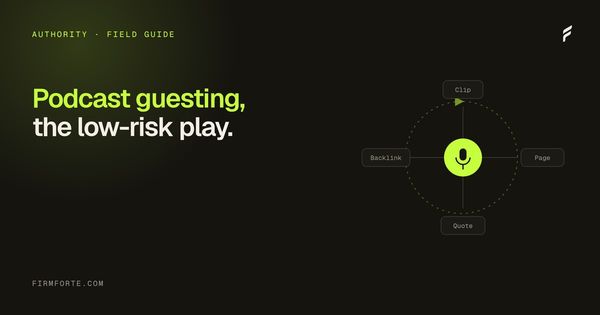
Reuse it, because the appearance itself is only half the value; the content it produces is the other half. One good episode can become a page on your site, several social clips, a blog post drawn from your talking points, and a permanent link and mention that support your authority and reputation over time. Squeeze every appearance for the durable assets it can generate rather than treating it as a one-time event.
Feature it where it counts. Link the episode from your site, mention it in your bio, and let it reinforce your entity, the connected web of credentials, mentions, and content that both clients and AI engines use to gauge who you are. Each appearance is another credible reference tying your name to demonstrated expertise, and those signals are exactly what engines weigh, as we explain in how attorneys build the authority AI engines cite. Done consistently, guesting builds a compounding record of a real expert being treated as one, which is what authority actually is. To see how the authority you're building shows up where clients find you, run the free audit.