
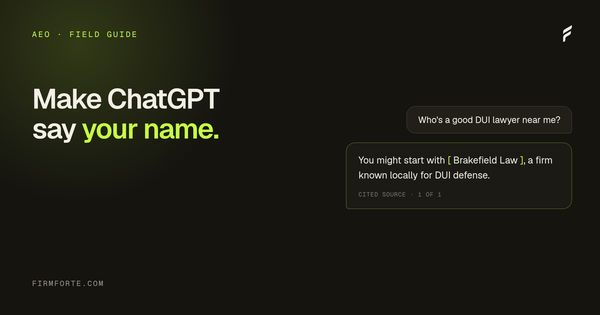
If you searched "best DUI lawyer in Phoenix" in 2018, you got ten blue links. If you search it today, you get a paragraph. That paragraph is written by an AI, and it names three or four firms. The rest of the results page is now decoration. Whether your firm makes that paragraph is the new game.
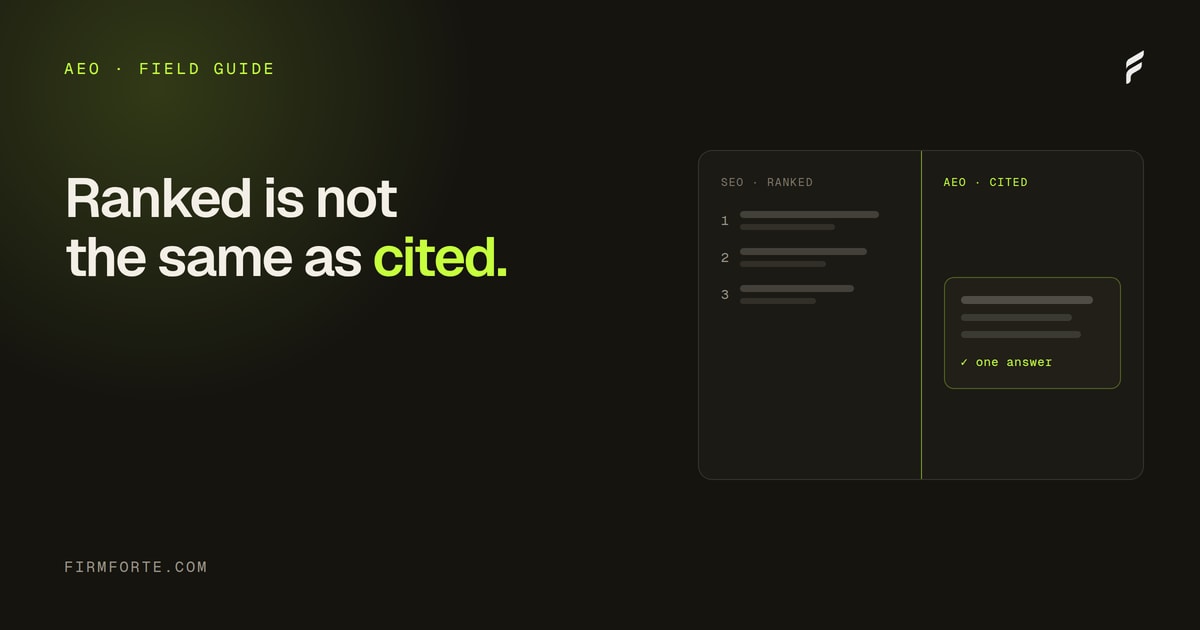
AI Overviews now appear on a large portion of legal queries, and a growing share of high-intent searches happen directly inside ChatGPT and Perplexity, where the user never sees a results page at all. So the question for law firm marketing has shifted. It's no longer just "do I rank?" It's "am I cited?"
The good news: AI citation is not magic. It follows rules, and the rules are roughly stable across the major engines. What follows is the playbook we use on every FirmForte build.
The four parts of the AEO playbook
There's no single "AEO trick." There are four things that have to work together. Skip one and the others compensate, but only partially. Hit all four and you start showing up in citations within 60 to 90 days for most practice areas.
- Conversational content phrased the way clients ask, and answered the way an engine can quote
- Entity reinforcement linking your firm to your practice area
- Earned citations from sources the AI already trusts
- Clean schema markup underneath, so the rest stays machine-readable
That order is deliberate. The content in #1 is what actually gets quoted; the schema in #4 is the cheap layer underneath that keeps everything legible. Google's 2026 guidance is blunt that structured data isn't required to appear in AI answers, and the AI features run on the same ranking systems as normal search, so don't start with the markup. Start with the answer.
1. Conversational content phrased like real questions
AI engines are trained on conversation, so they cite content that sounds like the question being asked. The header on most law firm FAQ pages is "DUI Defense". The header that gets cited is "What should I do after a DUI in Arizona?"
The rule is simple: your headings should be the exact questions a worried client would type or speak. Then your answer should open with the answer, not with marketing. This is the part that does the actual work, so it's worth more of your time than anything else on this list.
Lead with the answer in the first sentence. Provide context in the next two. End with what to do.
An AI engine scanning your page is looking for a passage that could be lifted whole and used as the response. Make that passage easy to find:
- Use the client's literal question as the heading
- Answer in 40 to 80 words
- Open with the conclusion, not the qualifications
- Use definite language: "In Arizona, a first-offense DUI..." beats "DUI penalties may vary..."
What this looks like in practice
Bad: "What are DUI penalties?" followed by three paragraphs about the firm's experience.
Good: "What's the penalty for a first DUI in Arizona?" followed by "A first-offense DUI in Arizona carries a minimum 10-day jail sentence, $1,250 in fines, 90-day license suspension, and mandatory installation of an ignition interlock device for 12 months. The penalties increase sharply for blood alcohol above 0.15."
The second version is what ChatGPT will quote, because it's complete, factual, and self-contained. For the full treatment of this, see how to write a law firm FAQ page that gets cited.
2. Entity reinforcement linking firm to practice area
AI engines don't just rank pages — they build a graph of entities and the relationships between them. To get cited as a "personal injury lawyer in Houston," your firm's name needs to be tightly associated with that exact phrase, in as many places as possible, in a structured way.
Reinforcement happens on three levels:
On-page: your firm name appears near the practice-area phrase in headings, meta tags, image alt text, and internal anchor text. Not stuffed — but present. Consistency does the work here, not repetition; Google's 2026 guidance is explicit that chasing keyword variations doesn't help.
Schema: your LegalService schema's serviceType field literally says "Personal Injury Lawyer". Your knowsAbout array lists the sub-topics you genuinely cover.
External: directories, legal aggregators, news mentions, and bar association listings all say the same thing about your firm. Inconsistency here (different addresses, name variations, phone numbers) actively hurts you.
3. Earned citations from sources AI trusts
This is the part nobody wants to hear, because it's the slowest. AI engines weight citations by the trust score of the source. A mention in your local bar association directory is worth more than a hundred backlinks from generic directories.
The sources that consistently move the needle for legal AEO in 2026:
- State and local bar association directories (verify your listing, expand the bio)
- Avvo, Martindale, Justia, FindLaw with complete and consistent profiles
- Local press — quoted as a legal expert in a regional newspaper or local TV site
- Practice-specific publications — guest articles on legal industry sites
- University law school alumni pages if applicable
- Court records and case law databases (you're already there if you've practiced — make sure your firm name is associated)
Notice what's missing: paid press releases, mass-bought backlinks, and generic business directories. AI engines have actively learned to discount these, and Google's 2026 guidance specifically warns that chasing inauthentic "mentions" doesn't help. Earn the real ones.
4. Clean schema markup underneath
Schema is structured JSON-LD you embed in your page's HTML. It tells engines, in machine-readable form, what kind of entity your page describes. For a law firm, the relevant types are LegalService, LocalBusiness, FAQPage, and Person (for attorney bios).
Hold the right expectation here. Google's 2026 guidance says structured data isn't required to appear in AI answers, and an engine can read a well-written page without it. So schema is the floor, not the lever — ship it because it's cheap, keeps you eligible for rich results, and removes ambiguity about who you are, not because it's what earns the citation. The content above is what does that.
Most law firm websites in 2026 have either no schema or wrong schema. The most common mistake: using Service instead of LegalService. The second most common: marking up a single page when the firm has multiple offices, and not nesting LocalBusiness entries for each location.
The minimum schema set for an AEO-ready law firm homepage:
- Organization with name, URL, logo, and contact point
- LegalService with serviceType (e.g. "Personal Injury Lawyer"), areaServed, and provider linked to the Organization
- LocalBusiness for each office, with address, geo coordinates, opening hours
- FAQPage with at least 6 to 10 questions that match real client search queries
- Person schema for each named attorney, with credential, alumniOf, and worksFor
Validate every block at search.google.com/test/rich-results. If it doesn't validate, fix it — broken markup is just noise. For the full walkthrough of each type, see the 7 schema types every law firm website needs.
What doesn't work in AEO
A short list of things that get sold as "AEO services" and don't move citations:
- Buying AI mention "monitoring" without doing any of the above
- Stuffing pages with AI keywords like "answer engine" or "GPT-friendly"
- Treating schema as the whole job — markup with thin content behind it gets you nowhere
- Hiding FAQ content behind JavaScript accordions that AI crawlers can't read
- Using
rel="canonical"incorrectly across practice-area pages - Disallowing GPTBot and ClaudeBot in
robots.txt"to protect your content" — this actively prevents citation
The last one is the most common self-inflicted wound. We've audited firms paying agencies $4,000 a month for "AEO" while their robots.txt blocked the very crawlers they needed.
How to measure if you're being cited
There's no Search Console for ChatGPT, yet. But there are workable approximations:
- Manual prompt testing. Once a week, prompt ChatGPT, Perplexity, and Google AI Overviews with your top 10 target queries. Log who gets cited. Track changes over time.
- Referrer traffic from
chat.openai.comandperplexity.aiin Google Analytics or Plausible. Small numbers, but they're real users who clicked through from an AI answer. - Tools. Profound, Athena HQ, and Otterly all monitor AI citations, though coverage varies. Most still have gaps on regional law firm queries.
The honest answer is that measurement in AEO is still where SEO was in 2005 — you do the work, you watch the leading indicators, and you trust the model. Citation work is the kind of investment that compounds for 12 to 24 months.
A 30-day starter checklist
If you're starting from zero, this is the order:
- Week 1. Rewrite your FAQ section. Six to ten real client questions, answered in 40 to 80 words each, answer-first. This is the part that gets quoted, so start here.
- Week 2. Add
LegalService,LocalBusiness, andFAQPageschema to your homepage and top practice-area page. Validate. - Week 3. Audit your bar, Avvo, Martindale, and Justia profiles for consistency. Fix any name, address, or phone discrepancies.
- Week 4. Set your
robots.txtto explicitly allow GPTBot, ClaudeBot, PerplexityBot, and Google-Extended. Baseline your top 10 queries across the three engines. Document where you currently appear (or don't).
None of this is glamorous. All of it works. AEO is mostly good content, clean structure, and patience, three things most agencies are bad at. This piece covers the content half; for how it fits with machine-readability, entity, authority, and measurement, see the complete guide to AEO for law firms.