
A criminal defense firm in Denver came to us last September with what they thought was an FAQ problem.
They had a 47-question FAQ page. Built over three years. The lead partner had personally written every answer. It ranked #4 in Google for "denver criminal defense lawyer faq" and got steady organic traffic. AI citations: zero. Across twenty test queries spanning DUI, drug charges, assault, theft, and white-collar defense, ChatGPT didn't reference the firm once. Perplexity returned three competitor firms in the average response. Two of those competitors had FAQ pages with eight and twelve questions respectively, both shorter and arguably less thorough than the Denver firm's.
This is the most common pattern we see on law firm FAQ pages. Length doesn't help. Effort doesn't help. The 47-question FAQ written by a partner who knows the practice cold can still be invisible to AI engines while a 10-question FAQ on a competitor's site gets cited daily.
The difference is in the writing. Most law firm FAQ pages are written for the wrong reader. They sound like a lawyer answering questions at a deposition. AI engines reward FAQ pages that sound like a lawyer answering questions at a coffee shop. The broader case for why content shape matters more than classic SEO formatting is in AEO vs SEO for law firms, and the underlying mechanics of AI extraction are in how to get cited by ChatGPT.
Here's why most law firm FAQs fail to get cited, the anatomy of a question and answer that does get cited, and the six question patterns AI engines extract from most often.
Five reasons most law firm FAQs are invisible to AI
One: questions phrased as keywords, not as humans speak. A real person types "How long do I have to file a DUI appeal in Colorado?" into ChatGPT. They don't type "Colorado DUI Appeal Statute of Limitations." Most law firm FAQs use the second form because the firm hopes Google will index it. AI engines extract the first form because that's what they get asked.
The Denver firm's first question was "Colorado Felony Sentencing Guidelines." That's a label, not a question. ChatGPT never quotes label-format FAQ entries because no human ever asks a question in that shape.
Two: answers that bury the answer. The classic legal answer opens with "It depends on many factors, but generally..." or "Each case is unique, however..." or "Without knowing the specifics of your situation..." That opening is appropriate in a consultation, where the lawyer is rightly being careful about overcommitting. It's poison in an FAQ answer because AI engines extract the first one or two sentences. If the first sentence is "It depends on many factors," the engine has nothing to extract and moves on to the next source.
The answer goes first. The caveats come second. The disclaimer comes third. A citation-worthy answer reads: "Two years from the date of the injury under Colorado Revised Statutes 13-80-102. Some exceptions apply for minors and for cases against government entities." That gets cited. "Each case is unique, but generally speaking, Colorado has a two-year statute of limitations" doesn't.
Three: no statute or rule citations. AI engines weight specificity. An answer that names the statute by section reads as authoritative; one that doesn't reads as a paraphrase. A firm that consistently cites statute numbers in its FAQ answers gets cited as a primary source. A firm that doesn't gets cited as a tertiary source, if at all.
This isn't lawyer-speak creeping back in. It's the opposite. Citing the statute is shorter, clearer, and more trustworthy than describing it without citation. The general rule from the schema types post applies even more strongly to FAQ Answer text than to body copy: name the statute, don't gesture at it.
Four: a content problem dressed up as a schema problem. Many law firm FAQ pages have FAQPage schema generated automatically (by Yoast, Rank Math, or a WordPress FAQ plugin), and it often doesn't match the visible HTML. Questions in the schema differ from the visible questions, or answers are truncated. Worth fixing for cleanliness, but keep it in proportion. Google's 2026 guidance says structured data isn't required to get cited, and the thing an engine actually quotes is the visible answer on the page. So "no schema at all" isn't what's keeping a firm out of AI answers. Weak, hedged, generic answers are. A schema mismatch is usually just a symptom of a page nobody has maintained.
The diagnostic: paste your FAQ page URL into the Google Rich Results Test and compare the questions and answers it shows to what's visible on the rendered page. If they don't match, clean it up. Just know the bigger lever is almost always the answer text itself. For the broader pattern of how content shape affects whether you show up, see why your firm shows up in Google but not in AI Overviews.
Five: generic answers that could apply to any state. A page about Colorado DUI penalties that doesn't name Colorado-specific penalties (1 year first-offense license revocation, mandatory ignition interlock, statutory minimum jail time of 5 days for second offense) reads as a generic source. AI engines cite state-specific sources for state-specific queries. They cite generic sources only as last-resort fallbacks.
The Denver firm's 47 questions included six about DUI. None of them named a single Colorado statute, threshold, or penalty by number. They read as if they had been written for a national firm and lightly customized.
The anatomy of an FAQ entry that gets cited
Five rules, applied to every question and answer pair, produce citation-worthy entries. The Denver firm rewrote 12 of their 47 questions to follow this pattern. The other 35 stayed in place. Citation volume tripled from the 12 rewrites alone.
Anatomy of a cited answer
Worded the way someone types it: "How long do I have to file a DUI appeal in Colorado?" Not "Colorado DUI Appeal Statute of Limitations."
The actual answer, with the number or statute in it. "Two years from the date of injury under C.R.S. 13-80-102." No "it depends" up front.
Now the exceptions and variables. This is where "it depends" belongs, with the statutes for the exceptions named.
When to call a lawyer, specifically. "Talk to a personal injury attorney within two weeks of the injury," not "call us for a free consultation."
The FAQPage Answer text matches the visible answer word for word. Cleanliness, not a citation trick.
The question. Phrased exactly the way a real person would type it into ChatGPT. Starts with one of: How, What, Can, Do, When, Why, How much, How long. Includes the state or city if the answer is jurisdiction-specific. Uses plain-language nouns rather than legal terms when both exist (DUI not Driving While Ability Impaired, divorce not dissolution of marriage, custody not parental responsibilities).
The first sentence of the answer. The actual answer. Concrete, specific, sourced. If the answer is a number, the number appears in the first sentence. If the answer is a statute, the section number appears in the first sentence. No preamble, no caveats, no "it depends." The reader, and the AI engine, should be able to stop reading after the first sentence and have the answer.
The next two to four sentences. The qualifications and exceptions. This is where "it depends" belongs. Common exceptions, common variables, the situations where the first-sentence answer doesn't apply. Cite specific statutes or rules for the exceptions when possible.
The closing sentence. When to talk to a lawyer, and why. This is where the firm earns the consultation request without overpromising on outcomes. "If you're within the statute of limitations and considering filing, talk to a personal injury attorney within two weeks of the injury to give them time to investigate." Specific. Actionable. Not "call us for a free consultation."
The schema match. The FAQPage Answer text in the schema is the same as the visible Answer text on the page. Word-for-word match. No truncation. No "schema-friendly" rewrite that differs from what the user sees. The visible HTML and the schema agree. This is a cleanliness rule, not a citation trick — but mismatched schema is sloppy, and there's no reason to ship it.
The six question patterns AI engines extract from most
From our citation log across roughly 60 law firm sites we've audited or built over the last fourteen months, six question patterns produce the bulk of citations.
How long do I have to... The statute-of-limitations question. Every practice area has at least one version. PI: how long to file a personal injury claim. Family: how long to file for divorce after separation. Criminal: how long to appeal a conviction. Estate: how long to contest a will.
What can I recover... The damages question. PI: what can I recover in a wrongful death case. Family: what can I get in spousal support. Employment: what can I recover for wrongful termination.
Do I need a lawyer for... The do-it-yourself question. Counterintuitively, AI engines often cite firm-written answers to this question even when the firm's answer is "yes you need a lawyer." The clarity of the answer matters more than its self-serving direction.
What happens if... The procedural-consequence question. What happens if I miss the statute of limitations. What happens if I refuse a breathalyzer. What happens if my spouse contests the divorce.
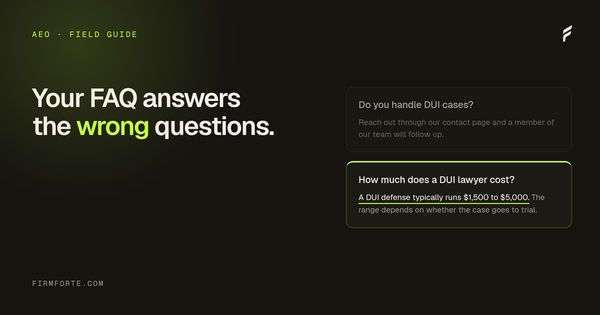
How much does... The cost question. How much does a divorce cost. How much does a DUI defense cost. How much does it cost to file a personal injury lawsuit. Many firms refuse to answer this question on their site because cost is variable. The firms that give honest ranges (with the variables that move them) get cited.
Can I sue for... The cause-of-action question. Can I sue for emotional distress. Can I sue my landlord for a slip and fall. Can I sue an uninsured driver.
An FAQ that covers all six patterns for the firm's practice area, with citation-worthy answers, is the highest-impact page on most law firm sites. The Denver firm's 47-question FAQ had partial coverage of three of the six. Their 20-question successor (built from the 12 rewrites plus 8 new questions in the missing patterns) covers all six and outperforms the original by every measurable metric. The architectural point about how FAQ pages sit inside a broader reference structure is in build a knowledge base, not a blog.
Five bad-to-good rewrites
The pattern, applied. Five real examples from the Denver firm's FAQ rewrite.
Before: Colorado Felony Sentencing Guidelines
"Colorado uses presumptive sentencing ranges for felony offenses, with specific ranges depending on classification. Class 1 felonies are the most serious..."
After: How long is a typical prison sentence for a Class 4 felony in Colorado?
"Two to six years in prison and up to three years of mandatory parole under Colorado Revised Statutes 18-1.3-401. The presumptive range applies unless aggravating factors are present, in which case the sentence can be extended to twelve years. Most first-time Class 4 felony defendants without aggravating factors are sentenced in the lower half of the range."
Before: DUI Penalties in Colorado
"Colorado imposes serious penalties for driving under the influence, including jail time, fines, and license suspension. The exact penalties depend on the circumstances..."
After: What are the penalties for a first-offense DUI in Colorado?
"Five days to one year in jail (with the five-day minimum often suspended for first-time offenders), a fine of $600 to $1,000, a nine-month driver's license revocation, and 48 to 96 hours of community service under Colorado Revised Statutes 42-4-1301. The license revocation can be reduced to one month if the driver enrolls in an interlock program for the remainder of the original revocation period."
Before: Plea Bargain Process
"In criminal cases, defendants often have the option of entering into a plea agreement with the prosecution. This involves..."
After: Can I get a plea bargain if I'm charged with a felony in Denver?
"Yes, in most cases. The Denver District Attorney's Office offers plea agreements in roughly 90% of felony cases, typically involving a reduction of the original charge to a lesser felony or a misdemeanor in exchange for a guilty plea. The decision to offer a plea is at the prosecutor's discretion and depends on factors including the strength of the evidence, the defendant's criminal history, and any cooperation in related cases."
Before: Drug Possession Laws
"Colorado classifies drug offenses based on the substance and quantity involved..."
After: How much methamphetamine triggers felony charges in Colorado?
"Any amount of methamphetamine possession is a Level 4 drug felony in Colorado under Colorado Revised Statutes 18-18-403.5, carrying a presumptive sentence of six months to one year in jail. Possession of more than four grams elevates the charge to a Level 3 drug felony, with a presumptive sentence of two to four years in prison."
Before: Domestic Violence Cases
"Domestic violence charges in Colorado are taken seriously by both prosecutors and the courts..."
After: What happens after a domestic violence arrest in Denver?
"A mandatory hold without bond until the defendant appears before a judge, typically the next business day, followed by a mandatory protection order prohibiting contact with the alleged victim under Colorado Revised Statutes 18-1-1001. Even if the alleged victim asks the prosecutor to drop the charges, only the District Attorney can dismiss a domestic violence case in Colorado."
What changed for the Denver firm
The rewrite took six weeks. Twelve existing questions were rewritten to the pattern. Eight new questions were added covering the missing six-pattern coverage. The other 35 original questions were archived to a separate "general information" page so they wouldn't dilute the page's focus. FAQPage schema was rebuilt to match the rewritten visible content exactly.
The 90-day numbers: AI Overview citations across the 20 test queries went from 0 to 14. Perplexity citations went from 0 to 9. ChatGPT named the firm in the first three results for 11 of 20 queries (was 0 of 20). Direct consultation requests through the AI funnel went from approximately 3 per month to 17 per month. The driver was the rewritten answers, not the rebuilt schema — the schema just stopped contradicting them.
Total content effort: roughly 18 hours of partner time across the six weeks. The original 47-question FAQ had taken three years to write. The 20-question replacement took six weeks and outperformed the original on every metric.
The lesson isn't "shorter FAQs perform better." It's "FAQ entries written for AI engines and human readers simultaneously perform better than entries written for keywords or for the lawyer's preferred phrasing." The format constraints are tight but the cost of meeting them is low.
The audit you can run yourself
Five steps, each under fifteen minutes, that will tell you whether your FAQ page is working.
Step 1: read every question out loud. If any of them sound like keyword stuffing or section headings rather than something a person would type into ChatGPT, that question is dead weight. The Denver firm had 31 of 47 questions in this category.
Step 2: read the first sentence of every answer. If the first sentence is a hedge ("It depends," "Each case is different," "Without knowing the specifics"), the answer is not citation-worthy as written. The fix is to put the actual answer in sentence one and move the hedge to sentence two.
Step 3: count the statute citations. If your FAQ has fewer than one statute or rule citation per answer on average, you're underdelivering on the authority signal that AI engines, and skeptical readers, both reward.
Step 4: run the schema diagnostic. Paste your FAQ URL into Google's Rich Results Test. Confirm the questions and answers it extracts match what's visible on the rendered page. Any mismatch is worth cleaning up, even though the visible content is what does the work.
Step 5: check coverage of the six question patterns. Open the patterns above and count how many your current FAQ covers for your practice area. Below four of six, you're leaving citation surface on the table.
Most law firm FAQs we audit hit two or three of the five checks. The rewrite to hit all five takes one to two weeks of focused partner time and ships citation volume that compounds for the next twelve to eighteen months.
Send us your URL
If you'd like us to audit your FAQ page, send us the URL and your three highest-intent target queries. We'll check the schema, run the citation diagnostic, identify the questions worth rewriting and the patterns you're missing, and come back with a real quote for what it would take to ship the rewrite. Rewriting FAQ pages to get cited is part of our AEO content work. Free, no card required, no obligation to hire us afterward.