
A personal injury firm in Houston came to us in October with a specific complaint. They were ranking #2 in Google for "houston car accident lawyer," #3 for "houston personal injury attorney," and #2 for "18 wheeler accident lawyer houston." Three of their top revenue queries, all on page one, all delivering steady organic traffic for the better part of two years.
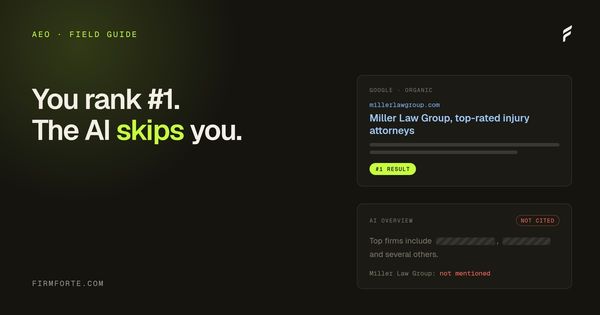
Their problem: AI Overviews. We ran their three queries through Google with AI Overviews enabled. Their firm appeared in none of them. We ran the same queries through ChatGPT and Perplexity. Zero citations across both engines on all three queries. Their two closest organic competitors were being cited in the AI answer that appeared above the blue links. The firm ranking below them in classic SEO was getting roughly 40% of the AI-attributable referral traffic.
This is the most counterintuitive pattern in modern legal search. A firm can be doing classic SEO correctly and still be invisible to the layer that sits above the blue links. Ranking in Google is necessary and no longer sufficient. The broader case for why these are separate disciplines lives in AEO vs SEO for law firms.
Five reasons explain why a top-ranking firm misses AI citations. The diagnostic is fast (under an hour per page). The fixes range from "edit your robots.txt and ship in twenty minutes" to "rewrite your service pages and ship in two weeks." Here's the order to run them in.
Reason one: your robots.txt is blocking the AI crawlers
Run this check first because it's the single most common cause and the cheapest fix.
Visit yourdomain.com/robots.txt. Look for any line that reads User-agent: GPTBot, User-agent: ClaudeBot, User-agent: PerplexityBot, or User-agent: Google-Extended, followed by Disallow: /. If any of those blocks exist, you are explicitly telling ChatGPT, Claude, Perplexity, or Google's AI training crawler that they cannot read your site.
The Houston firm had three of the four blocked. Their previous SEO agency had added the rules in 2024 "to protect content from AI scraping." The intent was reasonable. The effect was that none of the AI engines could see the site, and therefore none of them could cite it.
The diagnostic: open the robots.txt in a browser. Read each block. If you don't recognize a User-agent rule, find out what it blocks before assuming it's harmless. WordPress security plugins (Wordfence, iThemes Security), Cloudflare Bot Management, and several "AI protection" plugins all add these rules automatically. Website builders add their own version of this: GoDaddy and Wix configurations sometimes ship these blocks by default, one of several reasons website builders leave law firms nearly invisible in AI search.
The fix: a robots.txt that explicitly allows the four engines you care about looks like this.
User-agent: GPTBot
Allow: /

User-agent: ClaudeBot
Allow: /

User-agent: PerplexityBot
Allow: /

User-agent: Google-Extended
Allow: /

User-agent: *
Allow: /
You don't strictly need to allow them explicitly if the default is Allow, but the explicit declaration makes the intent obvious and catches any plugin that tries to override it later.
After the Houston firm's robots.txt was fixed, AI Overview impressions climbed from 8 in the prior 30 days to 41 in the following 30. Two of the three queries started showing the firm cited within six weeks. The other three reasons in this list explain why one query stayed invisible.
Reason two: no schema markup, or broken schema
The second most common cause, and the one with the biggest compounding return when fixed.
AI engines weight structured data heavily when deciding which firms to cite. A site with valid LegalService, FAQPage, and Person schema reads as a recognized entity. A site with no schema or with broken schema reads as ambiguous, and ambiguous sources don't get cited.
The diagnostic: paste your homepage URL into the Google Rich Results Test. Then paste your three highest-priority practice area pages. Look at what comes back. If the result is "No items detected" or shows only generic WebPage / Article schema generated by Yoast or Rank Math defaults, you don't have the schema layer that AI citation requires.
The seven types we recommend for law firm sites are covered in detail in the seven schema types guide. The short version: LegalService on the homepage, Person on attorney bios, Service on practice areas, FAQPage on Q&A content. Without these four at minimum, AI engines treat your firm as an unknown entity rather than a credentialed practitioner.
The Houston firm had Yoast SEO running with default settings. That generated WebPage and Article schema on every page, neither of which carries any signal about the firm being a law firm. We shipped LegalService and Person blocks in the second week of the engagement. AI Overview citations climbed from 41 in the previous 30 days to 89 in the following 30.
Reason three: your content isn't structured as questions and answers
Even with schema fixed, AI engines need extractable answers. The bulk of AI Overview citations come from passages that read "Here's the answer to that specific question" rather than from prose that wanders through context.
The diagnostic: open your three most important pages. Look at the H1 and the first paragraph. Does the H1 read as a question someone would type into ChatGPT? Does the first paragraph deliver a direct answer in 40 to 120 words?
Most law firm sites fail this check. The H1 reads "Houston Personal Injury Lawyer" (a label, not a question) and the first paragraph reads "At Hartman & Reyes, we have over 25 years of combined experience..." (a credential statement, not an answer).
For pages targeting AI citation, the structure that works is this. H1 phrased as a question ("How long do I have to file a personal injury claim in Houston?"). First paragraph as the direct answer ("Two years from the date of the injury under Texas Civil Practice and Remedies Code Section 16.003, with limited exceptions for minors and cases against government entities."). Then expand into the full context.
This doesn't mean your homepage has to be a question. It means that the deep pages where citation actually happens, the service pages, the FAQ pages, the resource articles, need to follow this shape. The build a knowledge base post walks through the editorial model in detail, and the get cited by ChatGPT playbook covers the exact HTML pattern.
The Houston firm rewrote eleven service pages over three weeks following this pattern. The two queries that had gone unaddressed by the schema fix started citing the firm within four weeks of the content rewrite.
Reason four: entity ambiguity
This one is harder to diagnose and slower to fix. AI engines have to disambiguate your firm from every other firm with a similar name, location, or focus. Weak entity signals mean the engine never confidently identifies you as the firm being asked about.
The diagnostic: open ChatGPT and type "Who is Hartman & Reyes PLLC in Houston?" (substitute your firm name). Watch what comes back. If the response is "I don't have specific information about this firm" or worse, hallucinates a different firm with a similar name, you have an entity problem.
Entity confidence is built from a handful of signals that have to agree across the web. The firm's name has to appear identically on the website, the Google Business Profile, the state bar listing, Justia, Avvo, the firm's LinkedIn company page, and a half-dozen legal directories. Inconsistencies (PLLC vs P.L.L.C. vs LLP, "Hartman and Reyes" vs "Hartman & Reyes") split the entity into multiple weak shadows of itself.
The fix is laborious. Audit every appearance of the firm name across the web. Standardize on one version, including punctuation and legal designation. Update Google Business Profile, all bar listings, all directories. This is normally a two-week project across an admin and a junior associate, mostly because the directories are slow to update.
The deeper mechanics live in the entities SEO guide. The short version: AI engines reward consistency disproportionately.
Reason five: no third-party reinforcement
The hardest reason and the one most firms get wrong.
AI engines don't just read your website. They cross-reference what your site says against what other sites say about you. A firm whose own homepage claims it handles personal injury cases will get cited softly. A firm whose homepage claims it handles personal injury cases, AND has matching language on Justia, AND is mentioned in three local news articles, AND has bar profile descriptions that line up, gets cited confidently.
This is the off-site SEO problem reapplied to AI citation. Most firms have a website and a Google Business Profile and maybe a bar listing. That's three sources. The firms getting cited in AI Overviews typically have ten to thirty third-party reinforcements.
The diagnostic: search your firm name in quotes on Google. Count the legitimate third-party mentions in the first three pages of results. Bar associations, news sites, podcast appearances, legal directories with custom-written content (not just a name-and-address listing). Below fifteen real mentions, third-party reinforcement is probably the constraint.
The fix is slow. Real PR, real bar association involvement, real podcast appearances, real publishing in legal trade outlets. The off-site SEO guide covers the playbook in detail.
The Houston firm had this gap. They were a fifteen-year-old firm with thin third-party presence. We didn't fix it in 60 days. We shipped the first three reasons (robots.txt, schema, content structure) and recommended a 12-month off-site program for the rest. The citation rate after 60 days went from 0 of 20 target queries to 11 of 20. The remaining nine were the queries where third-party reinforcement was the binding constraint.
The diagnostic in 60 minutes
Walk through this checklist in order. Each step takes under fifteen minutes. By the end you'll know which of the five reasons is your binding constraint.
Step 1: open robots.txt. If GPTBot, ClaudeBot, PerplexityBot, or Google-Extended is disallowed, that's almost certainly the constraint. Stop here, fix it, wait two weeks, retest.
Step 2: run your homepage through the Google Rich Results Test. If LegalService schema is missing or broken, schema is your constraint. Fix the seven types, in priority order.
Step 3: check your three top service pages. H1 a question? First paragraph a direct answer? FAQPage schema present? If any of those is no, content structure is the constraint.
Step 4: ChatGPT identity check. Type "Who is [firm name] in [city]?" If the response is confused or hallucinated, entity ambiguity is your constraint.
Step 5: brand search audit. Quoted firm name in Google. Count real third-party mentions in the first three pages. Below 15, off-site reinforcement is the constraint.
Most firms hit reasons one and two as their binding constraints. The good news: those are also the fastest to fix. The robots.txt change is under an hour. The schema work is under thirty hours. Both produce visible AI Overview movement within four to six weeks.
The order to fix in
If two or more of the five reasons apply, ship the fixes in this order.
One: robots.txt. Highest return for smallest cost. Block any other work until this is right.
Two: schema layer. Compounds with everything downstream.
Three: question-format content on the three most important service pages. Real citations start showing up here.
Four: entity consolidation. Slow but necessary to lock in the gains.
Five: third-party reinforcement. Twelve-month program. Don't start this before the first four are done. The citations won't connect.
For the Houston firm, the sequence took 60 days for the first three and is now in month seven of a twelve-month off-site engagement. AI Overview citations went from 8 per 30 days to 89 per 30 days at the 60-day mark and 134 per 30 days at the six-month mark. Their organic ranking didn't move (they were already #2). Their qualified consultation requests through the AI-driven funnel went from approximately 2 per month to 17 per month.
Send us your URL
The 60-minute diagnostic above will tell you what's broken on your site. If you'd rather have us run it and write up the fix order, send us your URL and three target queries. We'll do the work, hand back a structural audit, and come back with a real quote for what it would take to ship the fixes. The fixes are the same work as our answer-engine optimization service. Free, no card required, no obligation to hire us afterward.