
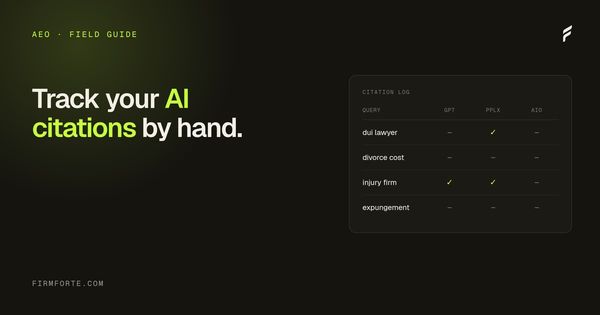
You can find out whether AI engines cite your firm in an afternoon, without buying a tool. Pick your most important queries, run each one a few times in clean ChatGPT, Perplexity, and Google AI Overviews sessions, and record whether your firm gets mentioned, cited, or skipped in favor of a competitor. Do it once a month and you have a trend line. It's not statistically perfect, but it turns "are we in AI answers?" from a shrug into a spreadsheet.
Here's the manual method, start to finish, and how to read what it tells you.
Why track AI citations at all?
Because you can't improve what you don't measure, and AI answers are increasingly the first thing a potential client sees. When someone asks ChatGPT or Google's AI Overview "who's a good estate planning lawyer in my city," the answer either includes you or it doesn't, and if you're not watching, you have no idea which. Tracking turns an invisible channel into one you can actually work on.
This matters more every quarter as people lean on AI to shortlist professionals. The firms that show up in those answers are quietly winning consideration before the traditional search results even load. You don't need to obsess over it, but you should know your baseline: which of your key queries surface your firm, which surface competitors, and whether that's moving in the right direction as you do the work. Flying blind here means you find out you're absent only when a client mentions they "asked ChatGPT and it recommended someone else."
What's the difference between a mention and a citation?
They're not the same thing, and the distinction shapes what you're looking for. A mention is when the AI names your firm in its answer text ("firms like Smith & Jones handle these cases"). A citation is when it links to a specific page on your site as a source. Both matter, but a citation with a link is the stronger signal and the one that can send actual traffic.
Track both, in separate columns, because they tell you different things. A mention means the engine knows your firm exists and associates you with the topic, which is largely an authority and entity-consistency question. A citation means a specific page of yours was good enough to be used as a source, which is more about that page being answer-first and extractable, the mechanics we cover in how Perplexity chooses which legal sources to cite. Seeing which you get, and which you don't, points you at what to fix.
How do you run the manual check?
Use clean sessions, run each prompt several times, and check across engines. Open a fresh, logged-out chat (or a separate account) so the engine's memory of you doesn't skew the answer, then run each of your target queries three to five times in ChatGPT, Perplexity, and Gemini, adding Google's AI Overviews for the searches that trigger one. Record each run as its own row.
The clean-session part is easy to get wrong and important. If you run these logged into an account the engine associates with your firm, its memory features will bias the answers toward what it thinks you want to see, which makes you look more cited than you are. Logged out, or in a private window, gives you the answer a stranger would get. Running each prompt multiple times matters too, because these systems are probabilistic and a single run isn't representative. A widely referenced guide to monitoring your brand in AI search recommends exactly this: run each prompt three to five times, in clean sessions, across the major engines, and log every run.
Which queries should you test?
Your money queries first: the searches a ready-to-hire client actually makes. "Best [practice area] lawyer in [your city]," "who should I hire for [specific legal problem] near me," and the informational questions that lead to hiring, like "what to do after [situation] in [state]." Fifteen to twenty-five prompts covering your real practice areas and locations is plenty to start.
Build the list the same way you'd build your keyword strategy: from genuine client demand, not from what sounds impressive. Include the high-intent hiring queries where being named is worth the most, a handful of the informational questions your clients ask on the way to a decision, and a few that name your competitors or your city specifically. Keep the list stable month to month so you're comparing like with like. The point isn't to test every possible phrasing; it's to watch a consistent, representative set over time and see whether your presence in it grows.
How do you make sense of the results?
Look for patterns across the runs, not a single verdict. For each query, note how often your firm appeared, whether it was mentioned or actually cited, which competitors showed up instead, and what sources the engine pulled from. After a couple dozen prompts run a few times each, the shape is clear: where you're strong, where you're absent, and who's eating your lunch.
Two patterns are especially useful. First, which competitors keep getting cited, because looking at their pages shows you what the engines currently reward for your queries. Second, which sources the engines lean on, directories, specific publications, particular firm pages, and very often Reddit, because that tells you where authority for your topics is concentrated. Reddit in particular shows up constantly, for reasons worth understanding, which we cover in what Reddit's dominance in AI citations means for law firms. Treat the whole thing as directional: running twenty-five prompts five times gives you a hundred-plus data points, enough to see obvious patterns, not enough to claim a precise "visibility rate." That's fine. You're looking for direction and change, not a lab result. The underlying reasons you're in or out are what we break down in how AI engines decide which law firm to cite.
How often should you check, and what do you do with it?
Monthly is the right cadence, and the output is a to-do list, not just a scoreboard. Re-run the same prompt set once a month, log the results next to last month's, and watch the trend. Where you're absent or losing, the fix is the actual AEO work: answer-first content, entity consistency, readable pages, and real authority. The tracking tells you where to point that effort.
One practical bonus: Perplexity is the exception where citations are always clickable, so any referral traffic it sends shows up cleanly in your GA4 under Acquisition, filtered to perplexity.ai. That gives you a second, passive signal alongside the manual check. But the manual spreadsheet is the core of it, and it's genuinely something a firm can do itself in an afternoon a month. The tracking is the easy part. Being the firm the engines want to cite is the work, and it starts with making sure they can even read your site, which we cover in how to check if ChatGPT can read your website. If you'd rather skip the afternoon, the free audit runs this check for you, and closing the gaps is the core of our AEO service.