
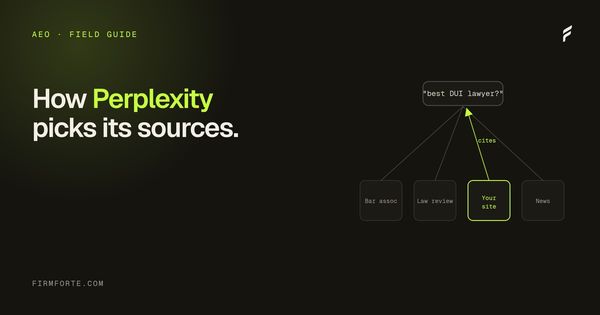
Perplexity chooses sources differently from Google, and understanding the difference tells you why some firms get cited there and others don't. It searches the web in real time, then runs what it finds through a ranking gauntlet before deciding what to quote. Three things carry most of the weight: whether your facts are cleanly quotable, whether your content is fresh, and whether you read like a real, credentialed source. Get those right and you're the kind of page it lifts an answer from.
Here's how the pipeline actually works, and what it means for a law firm trying to show up in Perplexity's answers.
How is Perplexity different from Google search?
Perplexity doesn't just rank pages; it retrieves them in real time and then synthesizes an answer with citations attached. Under the hood it runs a retrieval-augmented pipeline: it interprets your query, pulls candidate sources from a live web search, reranks them through several machine-learning layers, and writes an answer constrained to what those sources actually say, footnoting as it goes.
The consequence that matters is this: being retrieved is not the same as being cited. A breakdown of how Perplexity's answer pipeline works describes multiple ranking stages a source has to survive, and most content falls out somewhere in the middle. Google asks "which pages are most relevant to rank." Perplexity asks "which sources can I safely quote to build this specific answer." Those are different questions, and they reward different things. A page can rank respectably on Google and never once get cited by Perplexity, because it clears the first bar and fails the second.
What does Perplexity actually reward?
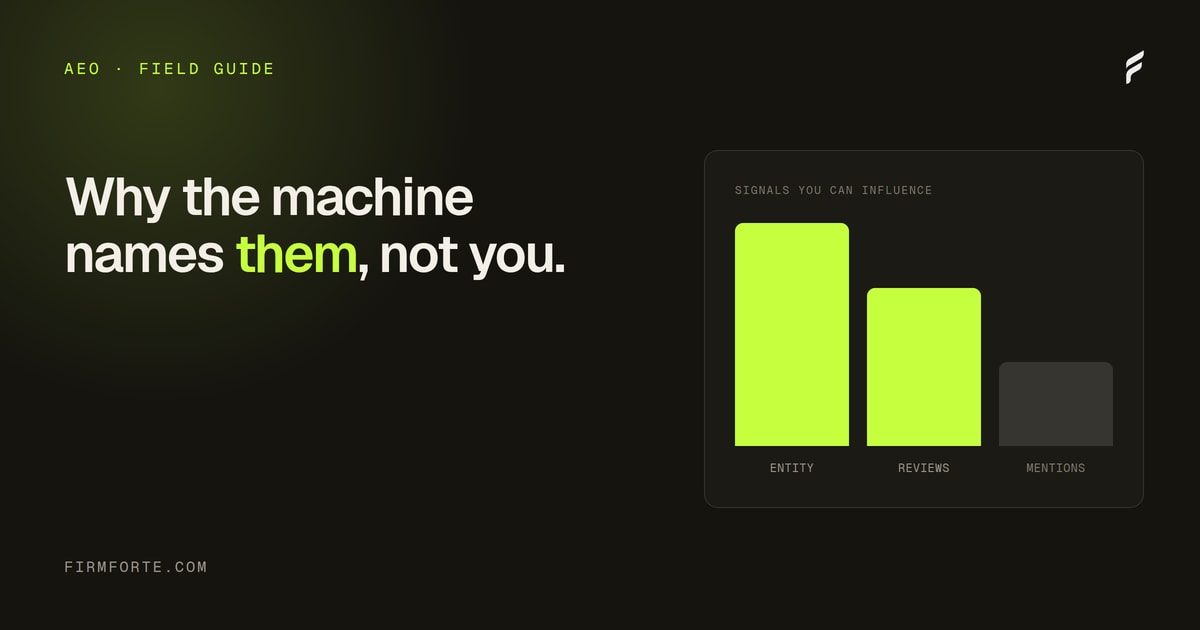
Extractability, freshness, entity clarity, and authority, roughly in that order of what trips firms up. It wants a fact it can lift cleanly and attribute, on a page that's recent, from a source it can tell is a real, identifiable entity, with enough authority to trust. Miss any one and you're likely to be retrieved and then passed over.
Those four are worth holding in your head as a checklist, because they're concrete and you control most of them. Can an engine pull a clean, standalone factual statement off your page and quote it? Is the page recent, or does it look stale? Is it obvious which real firm published it? And does the firm look credentialed enough to cite on a legal question? A page that answers yes to all four is the kind Perplexity prefers. The rest of this article is really just those four, one at a time.
Why does extractability matter so much?
Because Perplexity can only cite what it can cleanly quote. If your answer to a question is buried three paragraphs down, hedged, or spread across a page, the engine has nothing tidy to lift, so it moves to a source that put the answer up front. The strongest citations tend to come from pages that state the answer plainly in the first 100 words, before elaborating.
This is the single most actionable thing on the list, and it's the same answer-first structure that works across every AI engine. Lead each section with a direct, complete, standalone answer to the question it addresses, then explain. Write so that a single paragraph, pulled out on its own, still makes sense and still attributes cleanly to your firm. A page can be authoritative, current, and clearly yours, and still lose the citation to a weaker competitor simply because the competitor made their answer easy to quote and you made yours hard to find. We cover the mechanics of this across AI engines in how AI engines decide which law firm to cite, and it's the highest-return habit in the whole practice.
Why is freshness weighted more heavily here?
Perplexity has a stronger recency bias than most AI tools, because it searches live and leans toward current information. Recently updated pages routinely outrank older, even higher-authority ones on fast-moving topics, and because the search is real-time, well-optimized new content can start appearing in citations within days rather than months.
For a law firm, that cuts two ways, and both favor keeping content current. The upside is speed: a fresh, well-structured page on a current legal question can earn citations quickly, without the months-long trust-building that organic Google ranking needs. The downside is decay: a page you wrote three years ago and never touched looks stale to a recency-biased engine, and worse, if the law it describes has changed, it's now actively wrong. The fix is the same maintenance discipline that supports authority generally: keep your substantive pages reviewed and dated, so they read as current because they are. Freshness isn't a trick here; it's a signal that a real person is still tending the content.
What kinds of sources does Perplexity prefer?
Established, identifiable, credentialed ones. Government sites, recognized news outlets, and established publications tend to score higher than social posts or anonymous blogs, even when the writing quality is similar. The engine is trying to avoid citing something unreliable on a question that matters, so it leans toward sources it can tell are real and accountable.
A small law firm can't become a government website, but it can send the signals that separate a real, accountable source from an anonymous one. A named, credentialed attorney behind the content. A clearly identified firm with consistent details across the web. Citations to primary sources, the actual statute or rule, rather than vague assertion. These are the same authority signals that Google's quality framework rewards and that we lay out in how attorneys build the authority AI engines actually cite. Perplexity's preference for established sources isn't a wall around small firms. It's a reason to make your firm look unmistakably like the real, credentialed thing it is.
What does this mean for a law firm?
Write fresh, answer-first, clearly-attributed content from a credentialed source, and make sure the engine can reach it in the first place. That combination, a quotable answer up top, a current page, an obvious real firm behind it, on a site the crawlers can actually read, is what puts you in the running for a Perplexity citation. It's the same core work that serves every AI engine, tuned slightly for Perplexity's recency and extractability bias.
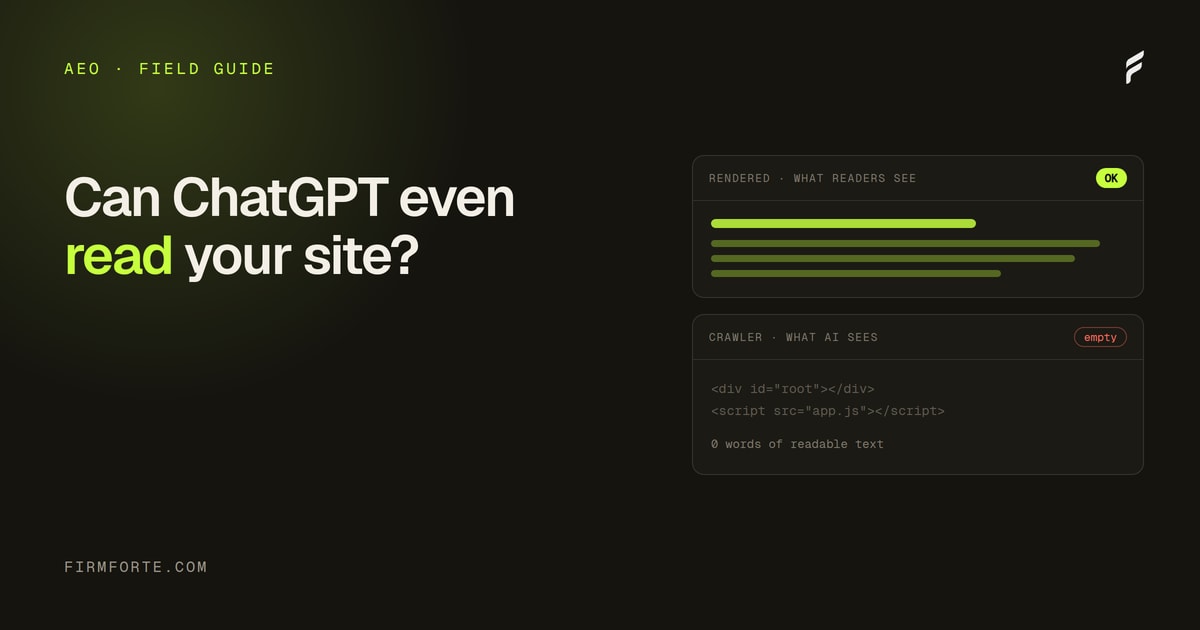
The honest boundary stays where it always is: nobody can promise you a citation, and any agency guaranteeing Perplexity will name your firm is selling something it can't control. What you can do is become the source these systems prefer, then make sure nothing technical is blocking them, which starts with confirming they can read your site at all, as we cover in how to check if ChatGPT can read your website. Do the readable-and-quotable work, keep it current, and let the citations follow the quality. To see whether the engines currently cite your firm or a competitor, run the free audit, and the ongoing work is the core of our AEO service.