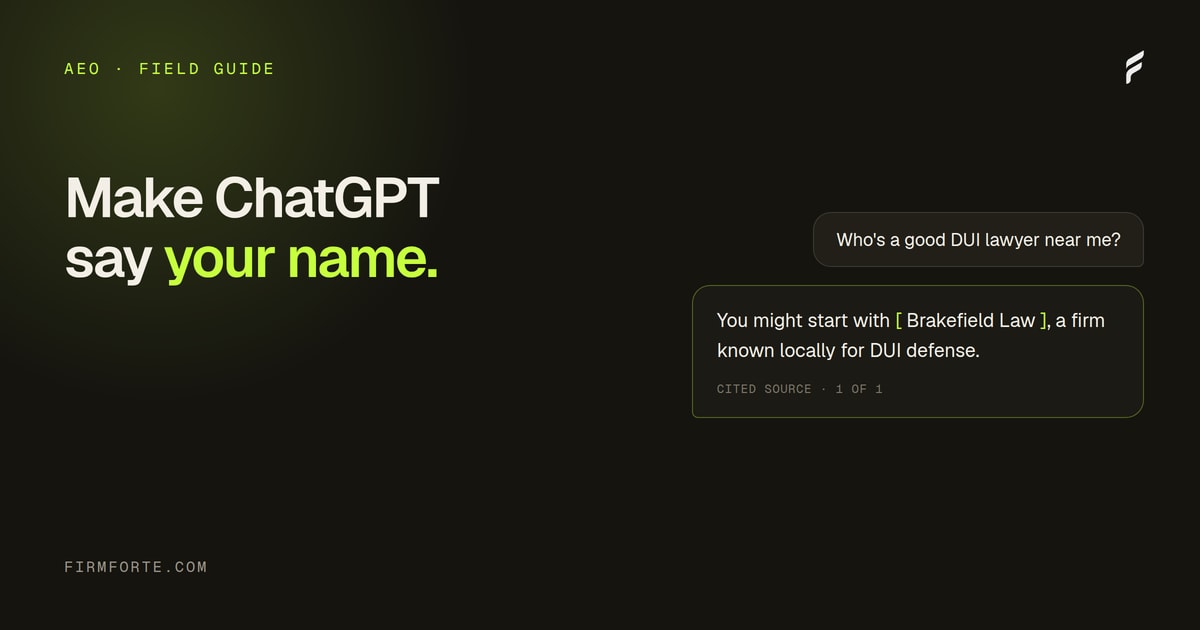

Ask ChatGPT for a "trademark attorney in Austin" and it doesn't hand back a list of ten links for you to sort through. It names one or two firms, maybe three, and moves on. That's the whole game now. Not ranking on a page. Being the firm that gets named.
So the question every lawyer should be asking isn't "where do I rank." It's "when an answer engine picks a firm to cite, how does it choose, and is there anything I can do about it." There is. But most of what agencies sell as the answer is the wrong thing, so let's start with how the decision actually works.
Retrieval, not ranking
Classic Google search ranks a list. It sorts pages by a few hundred signals and shows you the order. You, the human, click. AI engines work differently. They retrieve a small set of candidate sources, read them, synthesize an answer, and cite the handful that actually shaped what they said. The output isn't a ranked list you choose from. It's a written answer with a few names attached.
That changes the math. On a Google results page, being eighth still gets you seen. In an AI answer, being eighth gets you nothing, because the model only quoted the top one or two. The drop-off from "cited" to "not cited" is a cliff, not a slope. We walked through how this differs from traditional search in AEO vs SEO for law firms, and the mechanics of the citation itself in how to get cited by ChatGPT.
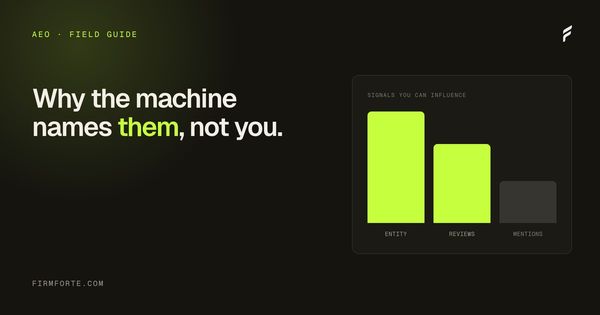
Underneath the retrieval, three things decide whether your firm makes the cut. You can move all three.
Signal one: the engine has to recognize you as a firm
An answer engine cites entities it's confident about. An entity is a thing the model has decided is real and identifiable: your firm, a named attorney, a city, a practice area. If the model isn't sure your firm exists as a distinct entity, it won't risk putting your name in an answer, because a wrong citation is worse for the engine than a vague one.
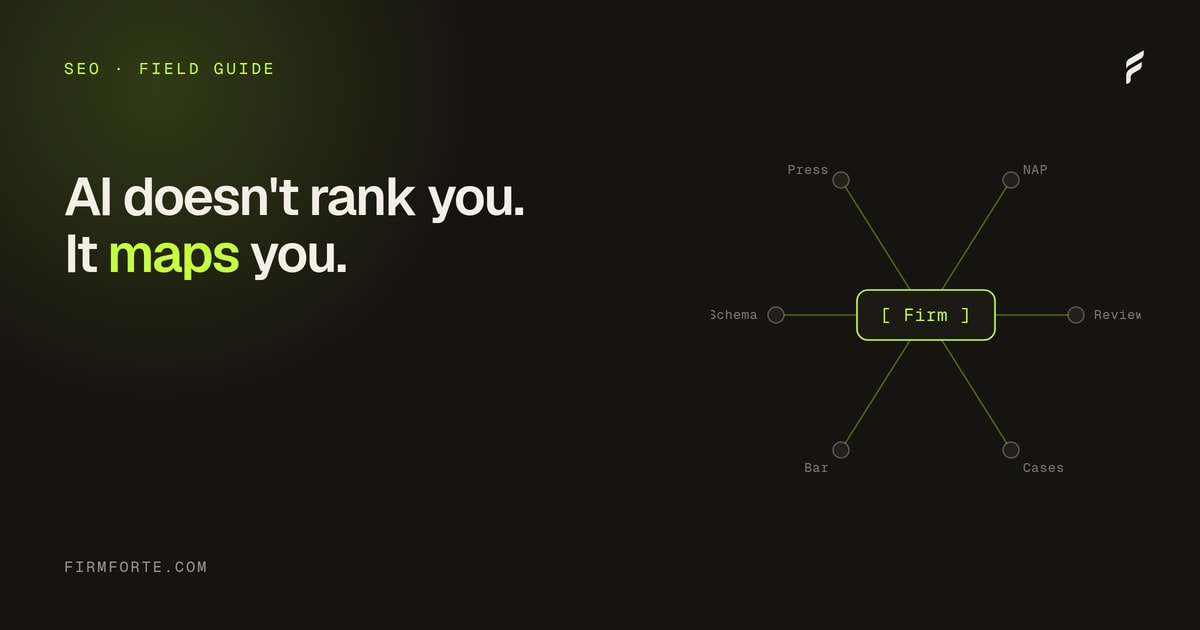
What makes a firm legible as an entity is boring and mechanical. Your name, address, and phone match exactly everywhere they appear: your site, your Google Business Profile, your state bar listing, Justia, Avvo, the local directories. The model sees "Reyes & Park, 412 Congress Ave, Austin" in eight places that agree, and it builds a confident picture. It sees three spellings of your firm name, two phone numbers, and an address that changed in 2023 on half the listings, and it builds a blurry one. Blurry entities don't get cited.
This is the single most common gap we find. Firms obsess over content while their name renders four different ways across the web. Fix the consistency first. We covered how engines assemble these entity pictures in entities and SEO for law firms.
Signal two: somebody other than you has to back it up
Your own website saying you're the best patent litigator in Houston counts for almost nothing. Of course your site says that. Every site says that. Answer engines weight claims that show up across independent sources, because corroboration is how they tell a real signal from marketing copy.
So the practice area you want to be cited for has to be confirmed by things you don't fully control. Your bar profile lists it. Justia and Avvo categorize you under it. A local news mention or a bar association article references it. A case writeup, a directory, a podcast, a guest column. Earning the harder ones there (the news mention, the podcast, the guest column) is what real digital PR does, and it's a different thing from the directory submissions most agencies invoice as digital PR: what digital PR for attorneys actually means. The model isn't counting backlinks the way old SEO did. It's checking whether the wider record agrees with your homepage. When it does, your claim is "true enough to repeat." When the only source is you, it's just an ad.
For a solo or small firm this is good news, because corroboration doesn't require a marketing budget. It requires showing up accurately in the places that already list lawyers. We laid out where to build that footprint in off-site SEO for law firms.
Signal three: the answer has to be easy to lift
Even when the engine trusts you, it still has to find a clean, quotable answer on your page. Models pull self-contained passages. A two or three sentence chunk that answers the question completely, in plain language, without needing the paragraph above it for context. If your answer to "how long do I have to file a Texas injury claim" is buried in the third paragraph of a 1,200-word page that opens with your firm's founding story, the model has to work to extract it, and it'll often pick a competitor who put the answer up top in a clean block.
This is why FAQ sections and question-shaped headings punch so far above their weight. Not because of any markup trick, but because the format physically matches what the model is looking for: a question, then a tight answer it can copy almost verbatim. We broke down how to write those blocks in how to write a law firm FAQ page that gets cited, and the broader case for structuring your whole site this way in build a knowledge base, not a blog.
The thing everybody overrates
Schema. JSON-LD markup gets sold as the secret to AI citations, and it isn't. Schema is hygiene. It helps Google understand your pages and makes you eligible for rich results, and a law firm site should absolutely have LegalService, LocalBusiness, FAQPage, and Person markup in place. We list all of them in the seven schema types every law firm site needs.
But schema is not a citation lever you pull to make ChatGPT name you. Adding FAQPage markup to a page nobody corroborates, for a firm the model can't cleanly identify, does nothing for citations. The markup describes content that already has to earn its place on the three real signals. Treat schema as the plumbing it is: necessary, invisible when it works, and worthless as a substitute for being a recognizable, corroborated firm with extractable answers. Anyone selling schema as the citation trick is selling you the easy part.
What you can't control, and why it's fine
A few things genuinely sit outside your reach. Which engine the client uses. How they phrase the question. A model's training cutoff, which means brand-new firms take time to register. You can't move those, so don't spend energy there.
What you can do is make yourself the obvious, low-risk choice the moment an engine goes looking. Recognizable entity, corroborated claims, answers it can lift. Get those three right and you're not gaming anything. You're just the firm that's easiest to cite correctly, which is exactly what these systems are built to reward. The diagnostic for why a firm gets skipped is in why your firm shows up in Google but not AI Overviews, and if you'd rather run the checks yourself, start with the 90-minute audit you can do this weekend.
None of this is fast. Entity consistency takes weeks to propagate, corroboration builds over months, and the citations follow after that. It compounds, though, the way a referral reputation does. The firms getting named in AI answers today started looking legible to the engines a year ago. The ones that start now get named next year. This is one piece of the larger subject, and the whole of it, from machine-readability to authority to measurement, is laid out in the complete guide to AEO for law firms. The full version of how we approach it is on our AEO page, and the on-page content and practice-area work it stands on is SEO for law firms.