
If an agency has pitched you a "llms.txt setup" as the thing that gets your firm into ChatGPT, save your money. As of 2026, no major AI engine reads llms.txt from a law firm's website. The file is real, it's cheap to make, and there's a modest case for having one. Getting cited is not part of that case, and anyone selling it that way is selling you the 2026 version of a meta keywords tag.
Here's what it is, what it does, and the honest reason to spend an afternoon on it and then forget about it.
What is llms.txt, exactly?
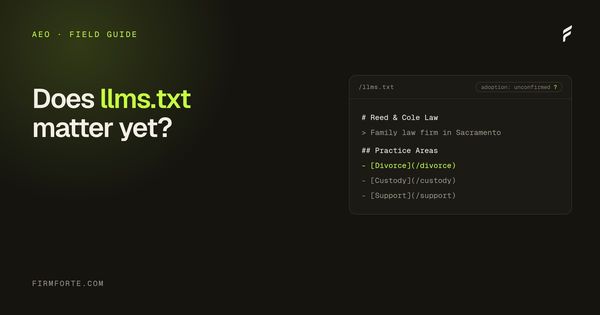
llms.txt is a plain-text file you put at the root of your domain that hands an AI model a curated reading list of your site. It was proposed in September 2024 by Jeremy Howard of Answer.AI as a way to point language models at your most important pages in clean Markdown, instead of making them wade through navigation, scripts, and cookie banners.
The idea borrows its shape from robots.txt and sitemap.xml. You write an H1 with your firm's name, a short blurb, then a Markdown list of links: your practice-area pages, your attorney bios, your contact page, your best guides, each with a one-line description. Some sites also publish an llms-full.txt that inlines the full text of those pages. The llms.txt proposal at llmstxt.org lays out the format. It's a sensible idea on paper. The problem is what's happened since.
Do ChatGPT, Claude, and Google actually read it?
No. As of 2026, no major AI provider fetches llms.txt from an arbitrary business website. Not OpenAI, not Anthropic, not Google. This isn't a hedge or a "results may vary." It's what shows up in server logs: the AI crawlers that visit your site don't request the file at all.
Ahrefs ran the check in mid-2025 and reported flatly that no major LLM provider supports llms.txt. Google's own search reps have said the same about Search: John Mueller compared it to the keywords meta tag, the one search engines stopped trusting a decade ago because the site owner controls it and can say anything. One log study covered by PPC Land found that 97% of published llms.txt files received zero AI requests, even as the number of files kept climbing.
Where does the confusion come from? OpenAI, Anthropic, and Perplexity all host an llms.txt on their own developer-documentation sites. That gets passed around as proof the standard has arrived. It hasn't. Those files exist so coding assistants like Cursor and Claude Code can pull structured API docs. That has nothing to do with whether GPTBot or ClaudeBot checks your firm's llms.txt when it's answering "best estate planning attorney in Tulsa." It doesn't.
So why would a law firm publish one at all?
Because it's close to free and it's good hygiene, not because it earns citations. It takes an afternoon, it can help IDE agents and internal tools that do read the file, and it might matter later if adoption ever turns real. That's the whole upside. Ship it with those expectations and you won't be disappointed.
This is the same stance we take on schema markup, and it's worth repeating because the sales pitch is identical. Structured data is hygiene and rich-result eligibility, not a trick that makes an engine cite you. llms.txt sits one rung below even that, because schema is at least read and used today. Publishing an llms.txt is fine. Paying a monthly retainer line item for it is not. If a proposal has "llms.txt optimization" as a recurring deliverable, you're being charged for a file that takes less time to write than the invoice does to read.
What actually gets a firm cited instead?
The work that was already working before llms.txt existed. Answer-first content that responds to the questions people actually ask, an entity that's consistent everywhere your firm is named, clean HTML an engine can read without running JavaScript, and genuine authority signals off your own site. None of that is a file you drop at your root.
We've written the long version of this in how AI engines decide which law firm to cite, and the practical checklist in how to get cited by ChatGPT. The short version: engines quote the page that answers the question cleanly and comes from a source they can verify is real. The markup, including the schema types every law firm site needs, makes your content legible. The content is what earns the citation. Skip the content work and the best-formatted llms.txt in the world changes nothing.
How to make one in ten minutes (and then move on)
If you want one anyway, here's the whole job. Open a text file, write your firm's name as an H1, add a sentence describing what you do, then list your 8 to 15 most important URLs in Markdown with a short description each. Save it as llms.txt, upload it to the root of your domain, and you're done.
Pick the pages you'd actually want an AI to read: each practice-area page, your about and attorney pages, your contact page, and two or three of your strongest guides. Skip the thin stuff. If you'd rather not hand-write the Markdown, our free llms.txt generator builds a clean one from your site in a couple of minutes, with no email required. Make it, publish it, and put your real attention on the things engines are reading right now.
That's the honest position. llms.txt is a tidy idea that the industry got out ahead of. Have one if you like the hygiene. Just don't confuse a file nobody's fetching with the work that gets a firm into the answer. If you want to see which of that real work your site is missing, that's what the free audit is for, and what our AEO service builds in from launch.