
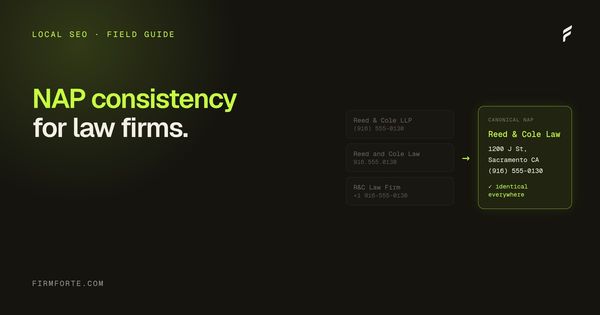
NAP consistency means your firm's name, address, and phone number match, character for character, everywhere they appear online. It sounds like housekeeping, and it matters far more than it sounds, because every mismatch fragments your firm into weaker, separate entities in Google's eyes and quietly drags down your local ranking. It's tedious, it's free, and cleaning it up is one of the highest-return afternoons you can spend on local SEO.
Here's why the format matters so much, where to look, and how to fix it.
What is NAP consistency?
NAP stands for Name, Address, and Phone, and consistency means those three details are identical every place your firm is listed: your website, your Google Business Profile, your state bar listing, and every directory like Justia, Avvo, or FindLaw. Not similar, identical. The same firm name, the same address formatting, the same phone number, with no stray variations.
The reason this is a named concept in local SEO at all is that businesses accumulate listings over years, created by different people at different times, and they drift. One directory has the old office address, another has a previous phone number, a third abbreviates the street differently, and the firm's own footer doesn't quite match any of them. Each of those is a small inconsistency, and collectively they add up to a confused signal about who and where your firm actually is. NAP consistency is just the discipline of making the whole web agree on your firm's basic facts.
Why does the exact format matter so much?
Because Google is constantly trying to decide whether all these mentions of your firm are the same business, and every mismatch makes that harder. When your details line up everywhere, Google is confident you're one real, established firm, which feeds the prominence signal that helps decide local rankings. When they don't, that confidence erodes, and your firm looks like several weaker, half-matching entities instead of one strong one.
The examples sound almost too small to matter, which is exactly why firms ignore them. "Suite 200" on your website and "Ste. 200" on your Google Business Profile. A phone number with your main line in one place and an old number lingering in a directory. Your firm name with "LLP" in some listings and without it in others. Each mismatch is a tiny vote against your firm being one confident entity, and while any single one is trivial, the pattern is what Google reads. This is the same entity-reinforcement logic we cover in entity SEO for law firms: you want every signal pointing at one clear, consistent firm, not a scatter of near-duplicates.
Where does your NAP actually appear?
More places than you'd guess, which is why an audit is worth doing. Start with the obvious ones and work outward: your website footer and contact page, your Google Business Profile, Bing Places, the major legal directories (Justia, Avvo, FindLaw, Martindale), your state and local bar listings, your social profiles, and the structured data in your site's schema. Every one of those is a place your NAP lives and can drift.
The legal-specific listings are easy to forget and important, because directories like Avvo and Justia carry weight in your space and are often populated with outdated information you never entered yourself. Your bar association listing is another one firms rarely check. Make a simple inventory of every place your firm is listed, then you have a checklist to standardize against. The goal isn't to be on every directory in existence; it's for the ones you are on to all say the same thing.
How do you fix inconsistent NAP?
Pick one canonical format, then make everything match it. Decide exactly how your name, address, and phone should read, down to the abbreviations and punctuation, and treat that as the single source of truth. Then work through your inventory and update every listing that disagrees, starting with the highest-value ones: your own site, your Google Business Profile, and the major directories.
Consistency matters more than which format you pick, so don't overthink the choice, just make it and enforce it. Update your own website first, since that's the anchor and the one you fully control. Then your Google Business Profile, then the big directories, then the long tail as you find them. Some listings you'll have to claim before you can edit, which is worth doing for the major ones. It's genuinely tedious work, and it genuinely outperforms a month of blogging, because you're strengthening the foundational signal that tells Google your firm is one real, findable business.
What about call-tracking numbers?
Call-tracking numbers are the most common way firms accidentally wreck their NAP. When an agency swaps a tracking number onto your website or a directory to measure calls, it introduces a phone number that doesn't match your real, consistent one, and if it's used inconsistently across listings, it fragments the exact signal you're trying to protect. Tracking has value, but done carelessly it undermines your local SEO.
If you use call tracking, handle it deliberately: keep one consistent primary number as your canonical NAP everywhere it counts, and if you deploy tracking numbers, do it in ways that don't scatter conflicting numbers across your citations. This is one of those places where a marketing tactic and your local ranking can quietly work against each other, and where a firm should ask its agency how the tracking is set up. A tracking number that improves your reporting while degrading your NAP consistency may be costing you more in rankings than it's worth in data.
How does NAP connect to your schema and profiles?
The NAP in your website's structured data has to match too, because your LocalBusiness and LegalService schema state your name, address, and phone in a machine-readable form. If the schema disagrees with your visible footer or your Google Business Profile, you've created an inconsistency in the one place engines read most precisely. The schema NAP is part of the same single source of truth.
So NAP consistency ties the whole local picture together: your visible site, your structured data, your Google Business Profile, and your directory listings all stating the same facts, which is what makes the schema types in a multi-location or single-office setup actually reinforce each other. Get your one canonical NAP, put it everywhere including your markup, and you've strengthened the foundation the rest of your local ranking is built on. The full local picture, from profile setup to reviews, is in the Google Business Profile guide from setup to map pack. To find where your firm's details currently don't match, run the free audit, and the full local cleanup is handled through our Google Business Profile service.