
A multi-location firm should have one Google Business Profile per real office, not a single profile for the whole firm and not extra profiles for cities where you don't actually have one. Google's rule is straightforward: one profile per staffed physical location, each with its own address, phone number, and permanent signage. Follow it and each office competes in its own local market. Break it in either direction, by consolidating real offices or inventing fake ones, and you either leave visibility on the table or risk getting your profiles suspended.
Here's how the rules actually work, and where firms get themselves in trouble.
Should a multi-location firm have one profile or many?
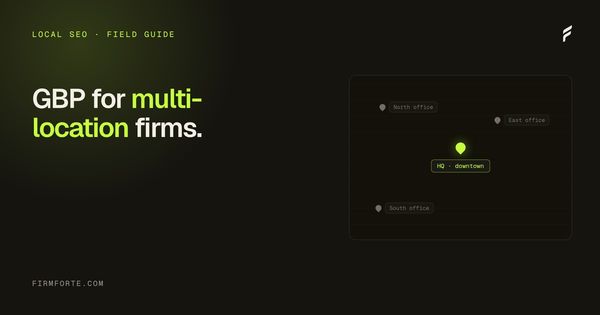
Many. Each genuine office should have its own Google Business Profile, because that's how each one becomes eligible to rank in the map pack for its own city. A single firm-wide profile can only rank around one address, which leaves every other office invisible to the local searches happening in its market. If you have three staffed offices, you want three profiles.
This is the upside of doing it right, and it's significant. The map pack is decided partly by proximity to the searcher, so a profile anchored at your downtown office does little for the suburb where your second office sits. A properly set up profile for that second office, with its own address and phone, makes it a real contender for "family law attorney [suburb]" in a way the head-office profile never could. Multiple profiles isn't about gaming anything; it's about accurately telling Google you genuinely serve multiple communities, so each one can find the office nearest them.
What are Google's rules for multiple profiles?
One profile per real location, and each has to be a real location. Google's guidelines for representing your business are explicit that you shouldn't create more than one profile per location, and that each profile must be a legitimate physical place: a unique address, a unique phone number for that office, permanent signage, and hours that reflect when staff are actually present there. The business name should be identical across every profile.
Those requirements are the guardrails, and they're enforced. A profile needs a real, staffed address with signage, not a spot you rent occasionally. The phone number should be specific to that location, not the same central line pointed at every profile. The hours should be real hours when someone is there. And the firm name must match across all of them, so Google can see they're branches of one business rather than separate entities. Meet those conditions for each genuine office and you can run as many profiles as you have offices, cleanly and within the rules.
Can you create a profile for a city where you don't have an office?
No, and this is the trap that gets firms suspended. A virtual office, a mailbox, a coworking desk you don't really operate from, or an address where no staff actually work is not eligible for a Business Profile. Creating one for a city you'd like clients from but don't have a real presence in violates Google's guidelines, and when it's caught, the profile gets suspended, sometimes taking your legitimate ones down with it in the review.
The temptation is understandable and the risk isn't worth it. Firms see the map pack driving calls in neighboring towns and want in, so they spin up a profile at a virtual address to compete there. Google has gotten good at detecting these, and a suspension is far more damaging than never having had the profile. This is the local-profile version of the same mistake we wrote about in why we stopped building location landing pages: manufacturing a presence you don't have tends to backfire. If you want cases from a nearby city, the honest routes are a strong practice-area page and, if the volume justifies it, a real office there, not a fake pin on the map.
How should you name and set up each profile?
Identical firm name, distinct location details. Every profile carries the same business name, exactly, while each gets its own address, its own local phone number, and its own accurate hours. Don't stuff a city or practice area into the name of a branch to try to rank better; keep the name true and let the address and category do the local work.
Consistency is what tells Google these are one firm with several offices rather than a suspicious sprawl. Same name everywhere, correct and unique location data on each, the right specific category on all of them, as covered in the full Google Business Profile guide from setup to map pack. Each office should also have a matching location page on your website, so the profile and the site agree about where that office is and reinforce each other. Set up this way, each branch presents as a legitimate, findable office, and the firm as a coherent multi-location business.
How do you keep NAP consistent across multiple locations?
Give each location one canonical name, address, and phone, and make the whole web agree with it, per location. Multi-location NAP is the single-location problem multiplied: each office's details need to match across your site, its Google Business Profile, directories, and bar listings, and the offices shouldn't be confused with each other. A mismatch fragments that location's identity the same way it would for a solo firm.
The discipline is per-office. Office A's address and phone should be identical everywhere Office A appears, and distinct from Office B's, with no crossed wires where a directory lists the downtown office with the suburb's phone number. This is more bookkeeping than a single-location firm faces, and it's worth doing carefully, because inconsistent multi-location data is both a ranking drag and a suspension risk. The reviews for each office matter too, gathered within your bar's rules, which we cover in a bar-compliant review strategy for law firms.
What about lawyers as individual practitioners?
Google does allow individual practitioners to have their own profiles, so a named attorney can have a profile distinct from the firm's, which is a genuine exception to the one-profile rule. But it's easy to overdo, and duplicate or overlapping profiles for the same lawyer at the same address create exactly the mess Google's rules exist to prevent. Use the practitioner allowance deliberately, not as a way to multiply pins.
For most small and mid-size firms, the clean setup is one profile per office, named for the firm, plus a practitioner profile only where it genuinely makes sense and doesn't duplicate an existing one. Keep it accurate, keep it non-duplicative, and you stay on the right side of the guidelines while giving each real part of your practice a chance to be found. To see how each of your offices currently ranks in its own market, run the free audit, and the full local setup across locations is handled through our Google Business Profile service.