
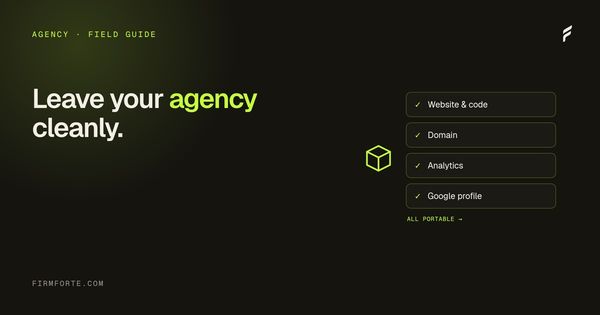
Leaving your marketing agency cleanly is almost entirely about order and preparation. Before you give notice, confirm you control the domain, get a working export of your site, secure every login, and plan your redirects. Do those first, in that order, and you walk away with your website, your rankings, and your bargaining power intact. Give notice first and then start asking for access, and you've handed the other side every reason to slow-walk you. The sequence is the whole game.
Here's how to run a clean exit, and what to watch for if the relationship was built to make leaving hard.
What can go wrong when you leave an agency?
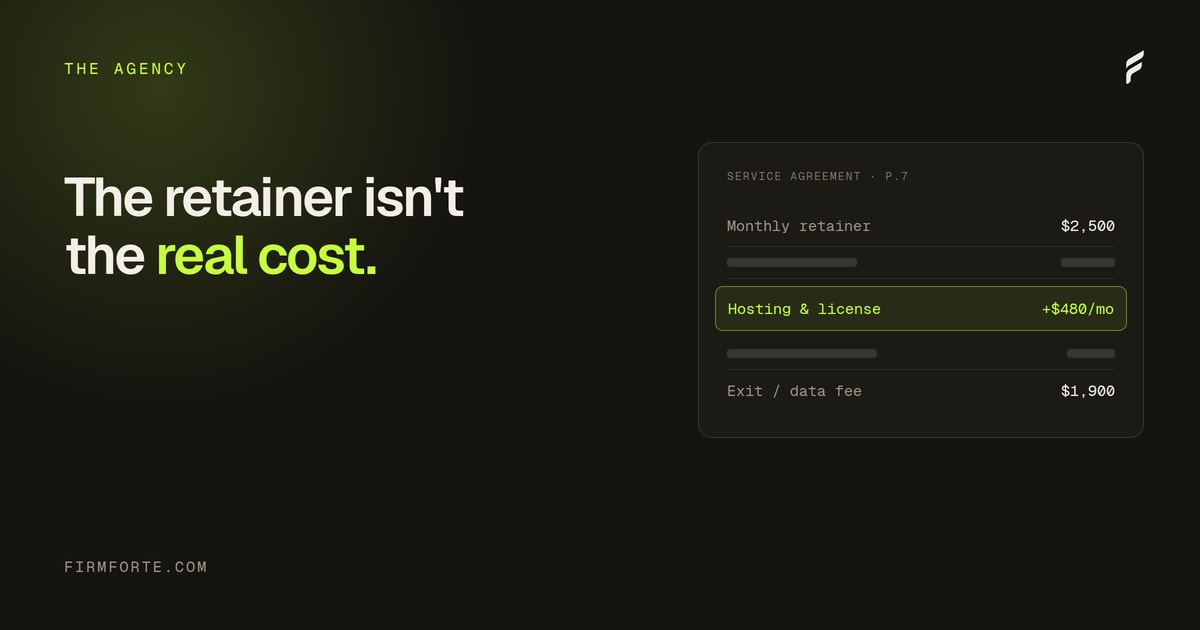
Plenty, if you leave unprepared. The common disasters: discovering the domain is registered in the agency's name, finding the site can't be exported because it's on their proprietary platform, watching your search rankings collapse when the old site disappears without redirects, and getting hit with early-termination fees you didn't know were in the contract. Any of these can turn a routine switch into a months-long mess.
The through-line is that all of these are preventable, and all of them get worse if the agency knows you're leaving before you've secured your position. An agency that owns your domain has the upper hand the moment you give notice. A proprietary platform you can't export becomes a rebuild you didn't budget for. The time to find out about these traps is before you announce anything, while you still have a cooperative relationship and full access, not after you've become the client on the way out. Preparation is the difference between an exit and a hostage negotiation.
What do you need to secure before giving notice?
Control and copies of everything, confirmed while the relationship is still normal. Specifically: verify the domain is registered in your name in a registrar you can log into, get administrative access to your hosting, Google Business Profile, Google Analytics, and Search Console, and obtain a full export of your website and its content. Do all of this quietly, before you announce you're leaving.
The cleanest way to check your position is the two-hour audit we describe in who owns your law firm website: request logins to the registrar, DNS, host, and every account, and note which ones come back without friction and which get a reason they "have to go through us." Do this as routine housekeeping, not as a farewell. If everything is genuinely yours and accessible, your exit is simple whenever you choose to take it. If some of it isn't, you've just learned that while you still have time to fix it, rather than at the worst possible moment. Either way, you want the answer before you give notice, not after.
How do you avoid losing your search rankings?
Preserve your URLs and redirect anything that changes. The rankings you've built live at specific web addresses, and if those addresses change or disappear without 301 redirects pointing the old ones to the new, the search equity evaporates. Carry your content over, keep the URL structure where you can, and map every old URL to its new home before the switch goes live.
This is the technical heart of a clean migration, and it's where a rushed exit does lasting damage. A firm that moves to a new site without redirects can lose months or years of ranking progress overnight, then blame the new site when the real culprit was the missing redirect map. If you're moving to a new provider, redirects and rankings preservation should be an explicit, written part of the plan, not an afterthought. A competent new partner treats this as standard; if the topic doesn't come up, raise it, because your rankings are an asset you paid for and you don't want to leave them behind with the old agency.
What about the contract and timing?
Read the termination clause first, then time your exit around it. Check your minimum term, your notice period, and whether there's an early-termination penalty, all of which live in the part of the contract most people skim, as we cover in the hidden fees legal agencies bury in contracts. Then give notice according to the contract, and line up your new build so it launches as the old relationship ends.
The timing move that saves the most money and disruption is simple: wait until your current term is up to avoid early-termination fees, and start your new site during the final month of the old contract so the new one is ready to launch the day the old obligation closes. That way you're never paying two providers at once and never sitting with a dead site in between. A month of overlap on the build, planned deliberately, turns a stressful cutover into a scheduled handoff. Rushing the exit out of frustration is how firms end up paying penalties they could have avoided by waiting a few weeks.
What if your site is on a proprietary platform?
Then leaving means rebuilding, so plan for it rather than fighting it. When the site lives on an agency's own software, there's usually no clean export, so the realistic path is to build fresh on a portable platform, carry your content and rankings over carefully, and set up redirects so you keep your search equity. It's more work than moving a portable site, which is exactly why the platform choice mattered in the first place.
This is the scenario we walk through for firms switching off a big proprietary system, and the mechanics are the same regardless of who you're leaving: rebuild on something you'll own, migrate the content, redirect the URLs, and time it to your contract. It's also the strongest argument for building on a portable platform next time, so this is the last time you ever have to do it, which is the whole case in WordPress vs a proprietary CMS for law firms. A proprietary exit is doable. It's just a project, and knowing that going in lets you budget and schedule it instead of being surprised by it.
How do you know if your agency will make leaving hard?
Run the exit test, ideally before you ever signed, but it works now too. Ask what happens the day you leave: do you keep a working, exportable site, the domain, and every login? The shape of that answer, and how much friction you hit trying to get access, tells you exactly how hard this will be. Smooth access means an easy exit. Deflection and "that has to go through us" means the upper hand was never on your side.
If you're reading this because you're already unhappy, the lesson for next time is to choose on the exit, not the pitch, which is the whole subject of how to choose a law firm marketing agency without getting locked in. For right now, prepare quietly, secure your position, plan your redirects, mind your contract dates, and then give notice from a position of strength. To see exactly what you control and what a clean exit would take, run the free audit, and if you're weighing where to land, our posted terms are on the pricing page and lined up against other options in the comparison pages.