

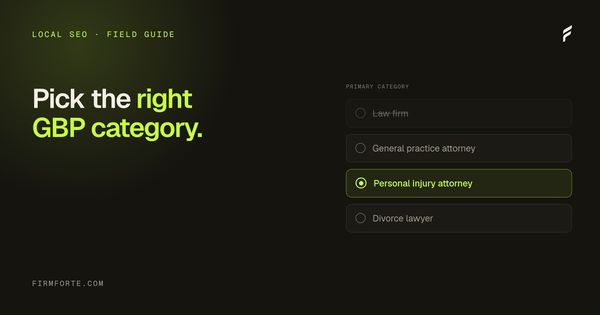
Your Google Business Profile category is the single strongest lever you control over which local searches you appear in, so a law firm should set its primary category to the most specific one that matches its main practice, then add secondary categories for the other services it genuinely offers. Pick a category that's too broad or slightly wrong and you'll be invisible for the exact searches your clients run. Pick the precise one and you tell Google exactly which map-pack results you belong in. Here's how to choose well.
The whole point of categories is that Google uses them to decide which searches trigger your profile. That makes this one of the highest-return setup decisions you'll make, and one of the most commonly botched.
Why does the primary category matter so much?
Because Google weighs the primary category far more heavily than any secondary one when it decides whether to show you for a given search. Your primary category is Google's core understanding of what your business is, and it drives most of your map-pack visibility. A criminal defense firm whose primary category is the generic "Law firm" instead of "Criminal justice attorney" is competing with every practice type in town rather than ranking for the specific searches it wants.
The rule that follows is: make your primary category the most specific one that matches your main practice area. Google offers granular legal categories, and the specific one almost always outperforms the generic "Law firm" for the searches that count, because it aligns your profile precisely with high-intent queries. Specificity is the advantage here, not a risk. The one that describes exactly what you do is the one that wins the searches you actually want.
How do I choose the right primary category?
Start from how your ideal client searches, then find the closest specific legal category Google offers. If your best cases come from people searching "personal injury lawyer," your primary category should be "Personal injury attorney," not the broad "Law firm." Match the category to the practice that pays the bills and that you most want more of, because that's the search you most want to win.
When a firm does several things, the primary category should reflect its priority practice, the one it wants to grow, not an even split across everything. You can't be primary in five things, so choose the one that matters most and let the secondaries carry the rest. If you're genuinely torn between two, weight it toward the higher-value or more competitive practice, where ranking is hardest to earn and most worth claiming. This choice sits at the center of the broader profile setup we walk through in the Google Business Profile guide from setup to map pack.
What about secondary categories?
Add a secondary category for every additional service you actually provide, because each one can help you surface for those related searches. A firm that does both family law and estate planning should set its primary to the main practice and add the other as a secondary, so it stays eligible for both sets of searches. Secondaries widen your reach across the services you really offer, without diluting the primary signal that anchors your profile.
The discipline is to add only categories that match services you genuinely deliver. Stuffing your profile with unrelated categories to catch more searches is a guideline violation that can get your profile suspended, and it muddies Google's read of what you are. List the practice areas you truly work in, leave off the ones you don't, and keep the set honest. A tight, accurate category list beats a padded one that risks the whole listing.
Should each attorney or practice have its own profile?
Usually no, one firm location gets one profile, but a genuine second office gets its own. Google Business Profiles map to physical locations, not to practice areas or individual lawyers, so a single-office firm that does three things runs one profile with one primary category and secondaries for the rest, not three profiles. Creating separate listings for each service at one address violates the guidelines and can trigger a suspension.
Real multiple locations are the exception, since each staffed office legitimately gets its own profile, and each can carry a category matched to what that office emphasizes. But the line is a real, distinct place of business, not a marketing convenience. If you run more than one office, the setup gets more involved, and we cover it in multi-location law firm Google Business Profiles. For a single office, resist the urge to multiply listings; one strong, correctly categorized profile is the goal.
What are the common category mistakes?
The frequent ones are defaulting to the generic "Law firm," picking a category that doesn't match how clients search, changing categories too often, and padding the list with services you don't really offer. The generic default is the most common and the most costly, because it leaves you competing against every firm in the area instead of the ones in your lane. Each of these quietly caps your visibility for the searches that would bring cases.
There's also the stability point: don't churn your categories. Constantly swapping your primary category can unsettle your ranking, so choose deliberately and then leave it unless your practice genuinely shifts. Set the specific primary that matches your priority practice, add honest secondaries, and hold steady. Your categories work alongside the other local signals, reviews, proximity, and NAP consistency, that decide the map pack, which is why category choice is one piece of a larger local strategy rather than the whole of it.
How do I know if I've got it right?
Test it against the searches you care about and watch whether you surface. Run the queries your clients would use, from within your service area, and see whether your profile shows up in the map pack for the practice areas you set. If you're absent for a search you should own, your category, or another local signal, needs work. The proof is in whether the right searches surface you, not in how the category reads to you.
Getting categories right is one of the fastest, cheapest local wins available, since it costs nothing and can shift which searches you appear in within days. To see whether your profile is set up to win the searches that matter, and where your local visibility stands overall, run the free audit, and the full local playbook, categories included, is in the guide to Google Business Profiles for law firms, with ongoing local work handled through our SEO service.